Calculation of intraprocedural hemodynamics with computational functional dynamic in mitral valve edge-to-edge repair
European Heart Journal


Abstract
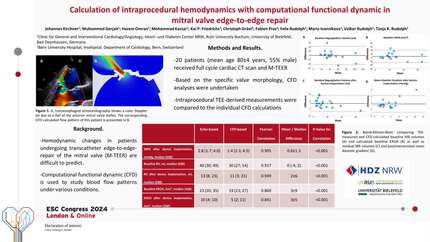
Hemodynamic outcomes in patients undergoing transcatheter edge-to-edge-repair of the mitral valve (M-TEER) are difficult to predict. Computational functional dynamic (CFD) is frequently used in biomedical engineering to simulate blood flow patterns under various conditions. The authors developed a standardized workflow for individualized analyses and investigated the hemodynamic of mitral regurgitation volumes and gradients by using CFD.
20 patients from two high volume centers who suffered from severe mitral regurgitation (MR) and underwent full cycle cardiac computed tomography (CT) prior procedure were enrolled. Baseline computed tomography and intraprocedural data were analyzed. Based on the specific valve morphology, individualized CFD-simulations were performed to calculate MR volumes prior to intervention and estimate hemodynamics after M-TEER.
CFD-analyses of 20 patients (mean age 80±4 years, 60% male) showed excellent correlation between baseline PISA method-based MR volumes (45±23ml) measured in transesophageal echocardiography (TEE) and CFD-based calculation (45±26ml; R=0.917; P<0.001) as well as between TEE-measured mean baseline effective regurgitant orifice area (EROA; 27±16mm²) and CFD-measured EROA (24±18mm²; R=0.869; P<0.001)). After device implantation, correlation between intraprocedural TEE-measured and CFD-estimated correlation for residual MR volumes (R=0.949; P<0.001) and EROA (R=0.841; P<0.001) remained robust. Post-interventional mean diastolic pressure gradient (TEE) was 3.6±2.8mmHg which was in close correlation with the CFD estimated gradient (3.0±1.8mmHg, R=0.905; P<0.001).
This is the first study to use a CFD-standardized workflow for predicting hemodynamic changes in patients undergoing M-TEER using data from two different centers. In the future, CFD-based analyses might serve as a key-diagnostic tool for predicting residual MR volumes and gradients for M-TEER-procedures. Comparison of TEE and CFD flow pattern Bland-Altman-Blots
Contributors



You may be interested in