One-year prognostic value of right ventricular to pulmonary arterial coupling in patients hospitalized for acute coronary syndrome: insights from the ADDICT-ICCU study
European Heart Journal


Abstract
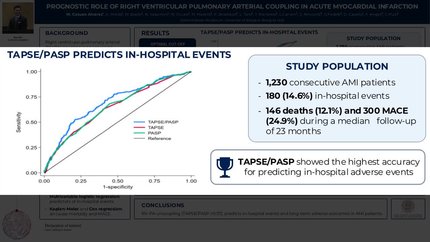
Tricuspid annular plane systolic excursion over systolic pulmonary artery pressure (TAPSE/sPAP) assessed by echocardiography is a good non-invasive approach for right ventricular to pulmonary artery (RV-PA) coupling assessment. Although the prognostic value of this ratio is well known in many cardiovascular diseases, its prognostic value in acute coronary syndrome (ACS) is not established.
To assess one-year prognostic value of TAPSE/sPAP among patients hospitalised for ACS.
In the prospective multicentric ADDICT-ICCU study, all consecutive patients hospitalized for ACS (either Non ST-Elevation Myocardial Infarction or ST-Elevation Myocardial Infarction) over two weeks in April 2021 at 39 centres across France were included. The TAPSE/sPAP ratio was measured using the first echocardiography performed within the first 24 hours of hospitalisation. The primary composite outcome was one-year major adverse cardiovascular event (MACE) including: all-cause death or urgent hospitalisation for acute cardiovascular reason (acute heart failure, urgent myocardial revascularisation). C-tree analysis was used to find the optimal TAPSE/sPAP cut-off to predict the primary outcome.
Among the 772 ACS patients (age 64±12 years, 74% males) included, 113 (15%) experienced 1-year MACE. The best cut-off for TAPSE/sPAP to predict 1-year MACE was 0.67 mm/mmHg. Patients with TAPSE/sPAP ≤0.67 mm/mmHg were more likely older (p<0.001), with previous atrial fibrillation (p<0.001), a higher length of hospitalization in ICCU (p<0.001), a higher NTproBNP (p=0.001) and a worse LVEF value (p<0.001). At one-year, all-cause death occurred in 27 (14%) patients with TAPSE/sPAP ≤0.67, compared to 7 (2.5%) with TAPSE/sPAP>0.67 (p<0.001), and 32 (16%) patients with TAPSE/sPAP ≤0.67 were hospitalised for acute cardiovascular reason against 20 (7%) with TAPSE/sPAP >0.67 (p=0.006). After adjustment for all traditional prognosticators, TAPSE/sPAP <0.67 mm/mmHg remained independently associated with the primary outcome (Table1): model 1 (comorbidities): HR 2.82, 95%CI[2.92-4.38], p<0.001, model 2 (echocardiography): HR=2.38, 95%CI [1,40-4,03], p<0.001). Patients with TAPSE/sPAP ≤0.67 mm/mmHg had worse event-free survival for the primary outcome: HR=2.92, 95%CI[1.98-4.29], p<0.001).
TAPSE/sPAP, a noninvasive approach for RV-PA coupling, was independently associated with 1-year MACE in patients hospitalised for ACS, even after adjustment with traditional prognosticators, including LVEF. Multivariable Cox analysis


You may be interested in