The association between left ventricular mass index and all-cause mortality
European Heart Journal


Abstract
Left ventricular hypertrophy (LVH) has been associated with a higher risk of all-cause mortality. However, there is a lack of optimal cut-off values for grading the severity of LVH in the general population.
We aim to investigate the association between the left ventricular mass index (LVMi) estimated by echocardiography and all-cause mortality and determine the optimal cut-off values of LVMi for the general population to predict outcomes.
Consecutive participants undergoing echocardiography in a tertiary medical center in Taiwan during 2005-2021 were enrolled. LVMi was calculated using the cube formula from the linear method. The primary outcome was all-cause mortality by linking to the National Death Registry. The association between LVMi and all-cause mortality was assessed using the joinpoint linear regression analysis to derive the optimal cut-off values for LVMi. Using the Kaplan-Meier methods, we validated our results with a community-based cohort with a long-term follow-up period.
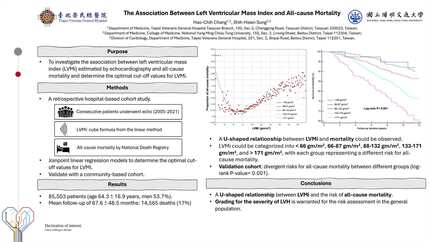
85,503 participants (age 64.3 ± 16.9 years, 53.7% men) were enrolled. During a mean follow-up of 67.6 ± 48.5 months, there were 14,565 deaths (17%). A U-shaped relationship between LVMi and the risk of all-cause mortality could be observed. The joinpoint linear regression analysis revealed that LVMi could be categorized into the following groups (less than 66 gm/m2, 66-87 gm/m2, 88-132 gm/m2, 133-170 gm/m2, and more than 171 gm/m2), with each group representing a different risk for all-cause mortality. (Figure 1) In the validated cohort categorized by the cut-off values of LVMi, the Kaplan-Meier analysis showed divergent risks for all-cause mortality between different groups in the community-indwelled populations (Figure 2, log-rank P-value< 0.001).
There was a U-shaped relationship between LVMi and the risk of all-cause mortality. Grading for the severity of LVH using the LVMi is warranted for the risk assessment in the general population.


You may be interested in