Feasibility, accuracy, and reproducibility of device sizing in virtual reality for percutaneous left atrial appendage closure - a single center study
European Heart Journal


Abstract
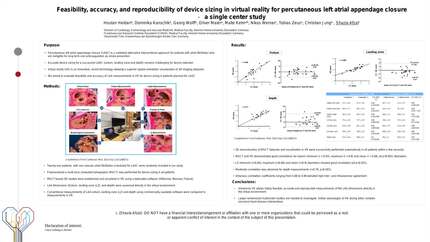
Left atrial appendage closure (LAAC) is a safe and effective procedure for stroke prevention in patient with non-valvular atrial fibrillation. Procedural planning and device sizing remains challenging due to the highly complex and variable three-dimensional (3D) anatomy of the left atrial appendage (LAA). Virtual reality (VR) is a innovative, recent technology allowing a superior spatial orientation visualization of 3D imaging datasets.
Therefore, we aimed to evaluate feasibility and accuracy of LAA measurements in VR for device sizing in patients planned for LAAC.
Twenty-one patients (79±7 years, 62% male) with non-valvular atrial fibrillation scheduled for LAAC were randomly included in our study. Preprocedural a multi-slice computed tomography (MSCT) was performed for device sizing in all patients. MSCT-based 3D models were established and visualized in VR using a dedicated software (VMersive, Warsaw, Poland). LAA dimensions (Ostium, landing zone (LZ), and depth) were assessed directly in the virtual environment. Conventional measurements of LAA ostium, landing zone (LZ) and depth using commercially available software were compared to measurements in VR.
3D reconstruction of MSCT datasets and visualization in VR were successfully performed automatically in all patients within a few seconds. MSCT and VR demonstrated good correlations for ostium minimum (r = 0.93), maximum (r = 0.8) and mean (r = 0.88, all p<0.001) diameters. Additionally, LZ minimum (r=0.84), maximum (r=0.86) and mean (r=0.9) diameters showed good correlation (all p<0.001). Moderate correlation was observed for depth measurements (r=0.76, p<0.001). Furthermore, intraclass correlation coefficients ranging from 0.88 to 0.98 denoted high inter- and intraobserver agreement.
Immersive VR allows highly feasible, accurate and reproducible measurements of the LAA dimensions directly in the virtual environment, hence enabling accurate device sizing for LAAC.
Contributors



You may be interested in