Effects of short-term exposure to high altitude on cardiac function
European Heart Journal


Abstract
What effect does short-term high altitude exposure have on heart function? Can people exercise in the highlands? what changes occur in heart function during exercise in highland areas? This study will explore these topics.
To investigate the difference of heart function between people at sea level and at high altitude, and to study the changes of short time exercise on heart function at high altitude.
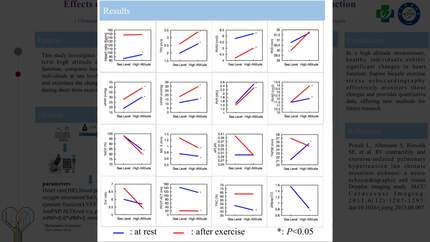
36 healthy subjects were recruited to go to high altitude area after underwent exercise echocardiography on a supine bicycle at sea level. They ascended to 3600m within 24 hours by bus.Another exercise echocardiography was performed on the day of arrival.Heart rate (HR), blood pressure (BP) and blood oxygen saturation (SaO2) were monitored in real time during both examinations. Parameters such as left ventricular ejection fraction, E/ E 'and mean pulmonary artery pressure (mPAP) after rest and exercise were calculated.ΔmPAP /CO was calculated by (mean mPAP at peak -mean mPAP at rest )/(mean CO at peak-mean CO at rest).
At peak exercise,SaO2,TRV,RVD2,SPAP,mPAP,PVR, ePLAR,RVAS,ΔMpap/CO were much higher at high altitude levels. (P < 0.001); E,A,FAC,ΔS were significantly lower than that of the sea leval; at rest, HR,TRV,sPAP,mPAP ,PVR were much higher at high altitude levels than at sea leval(P < 0.001),SaO2,RVOT ACT, were significantly lower than that of the sea leval(P < 0.001).
When healthy people are in high altitude environment, the heart function changes obviously. Supine bicycle exercise stress echocardiography can well monitor the heart function changes and provide quantitative data, providing new technical methods for future related research.

You may be interested in