Differences in myocardial work across functional class strata in a severe aortic stenosis AHA D1 population. A cross-sectional study
European Heart Journal


Abstract
Aortic stenosis is the most prevalent degenerative valvopathy. [1,2] The contractile state of the left ventricle has prognostic value in these patients. Global longitudinal strain (GLS) is the most accurate method for the estimation of myocardial performance. However, its value depends on the left ventricular afterload, [3,4] making GLS values challenging to interpret for decision-making purposes. The global myocardial work index (GWI) is an innovative echocardiographic technique for assessing myocardial function.[5] From these values, other indices representing constructive work, wasted work, and myocardial efficiency can be calculated.[6]
The objective of our study was to measure the GWI and its derivatives using transthoracic echocardiography and relate them to the patient's functional class.
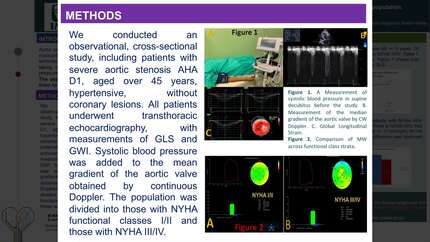
We conducted an observational, cross-sectional, and analytical study, including patients with severe aortic stenosis AHA D1, aged over 45 years, hypertensive, without coronary lesions. We exclude patients with other associated valvulopathies and rhythm disorders. All patients underwent transthoracic echocardiography, with measurements of GLS and GWI. Systolic blood pressure was added to the mean gradient of the aortic valve obtained by continuous Doppler. The population was divided into those with NYHA functional classes I/II and those with NYHA III/IV.
Between May 2022 and August 2023, we included 152 patients, average age was 68 +/- 9 years. Of these, 54% were male, 38% had type 2 diabetes, 36% had dyslipidemia, and 30% had a history of smoking. Regarding functional class, 21% were in NYHA class I, 37% in NYHA II, 32% in NYHA III, and 9% in NYHA IV. The mean LVEF of 60 +/- 5%, GLS strain of -15.1 +/- 3.1; mean GWI was 2251 +/- 595 mmHg%, while the global constructive work index was 2526 +/- 596 mmHg%. The median wasted work index was 198.2 (196-204.2) mmHg%, and the mean myocardial efficiency was 89.9 +/- 4.7%. The global myocardial work index was 2455 +/- 582 in patients with NYHA I/II vs 1978 +/- 527 mmHg% in patients with NYHA III/IV (p<0.001) (Table 1). For the global constructive work, patients in NYHA I/II had a mean of 2708 +/- 590 mmHg, while those in NYHA III/IV had 2281 +/- 542 mmHg% (p<0.001). There were no significant differences in wasted work (190 +/- 11 mmHg%, NYHA I/II vs 210 +/- 113 mmHg%, NYHA III/IV, p=0.27). Marginally statistically significant difference was observed for myocardial efficiency (91 +/- 4.8%, NYHA I/II vs 89 +/- 4.5%, NYHA III/IV, p=0.49).
Patients with severe aortic stenosis have supranormal myocardial work indices.[7] However, as the disease progresses and patients experience greater clinical deterioration, these indices decrease, showing a significant difference between functional classes I/II and III/IV. Further studies are needed to determine the utility of these indices as prognostic indicators in this patient group. Differences in myocardial work Bulley
Contributors

D Romero Zertuche
Author
Cardiology Hospital Siglo XXI National Medical Center, Mexico City Mexico City , Mexico
B Cruz Romero
Author
G Rodriguez Guzman
Author
Hospital of Cardiology at the Siglo XXI National Medical Center Mexico City , Mexico
E Gonzalez Alvarado
Author

You may be interested in