Physiologic pacing in congenitally corrected transposition of the great arteries with electroanatomic mapping guidance: a case report
European Heart Journal - Case Reports


Abstract
This case report details the application of left bundle branch pacing in a patient with congenitally corrected transposition of the great arteries (cc-TGA), a rare congenital heart defect characterized by anatomical complexities that pose unique challenges in the management of device-related complications and heart failure. The patient’s history is notable for complex anatomical considerations, cardiovascular implantable electronic device (CIED) infection, and heart failure.
The patient underwent a series of interventions, including treatment for pocket-site infections, abandonment of epicardial leads, and an unsuccessful attempt at trans-catheter leadless pacemaker implantation. Given the patient’s complex anatomy and prior CIED infection, traditional pacing methods were deemed unsuitable, leading to the selection of left bundle branch pacing. The lead implantation was guided using 3D electro-anatomical mapping to ensure synchronous physiologic pacing in a patient with heart failure.
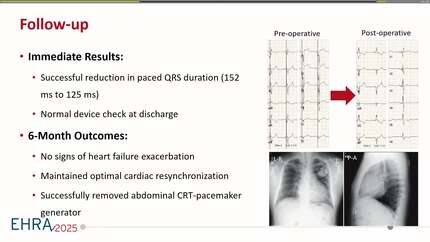
The case underscores the heightened risks faced by cc-TGA patients, with a focus on systemic right ventricular dysfunction and pacing-induced ventricular dysfunction. In these patients, ventricular synchrony is critical and can be achieved with biventricular pacing. Physiologic pacing emerges as a promising alternative to cardiac resynchronization therapy (CRT), especially in cases where endovascular CRT is unfeasible. This case demonstrates the utilization of 3D electro-anatomical mapping for achieving successful physiologic pacing in complex congenital heart lesions. At the 12-month follow-up, the patient presented with stable clinical status and a narrow QRS complex. Echocardiography indicated improvement in the right systemic ventricular function.
Contributors

Kirill Buturlin
Author
Shimon Kolker
Author

Flemming Javier Olsen
Author
Ugur Canpolat
Author
Vera Maslova
Author
Abdelsalam Bensaaud
Author
You may be interested in