Von Willebrand factor exacerbates heart failure through formation of neutrophil extracellular traps
European Heart Journal


Abstract
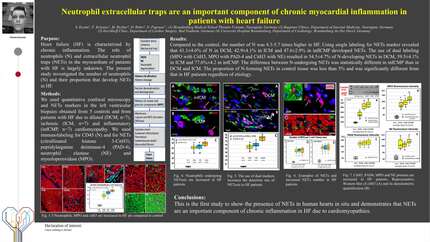
Heart failure (HF) is a leading cause of mortality worldwide and characterized by significant co-morbidities and dismal prognosis. Neutrophil extracellular traps (NETs) aggravate inflammation in various cardiovascular diseases; however, their function and mechanism of action in HF pathogenesis remain underexplored. This study aimed to investigate the involvement of a novel VWF-SLC44A2-NET axis in HF progression.
NET levels were examined in patients with HF and mouse models of transverse aortic constriction (TAC) HF.
Elevated NET levels were observed in patients with HF and TAC mouse models of HF.
This study established the role of a novel VWF-SLC44A2-NET axis in regulating mitochondrial homeostasis and function, leading to cardiac apoptosis and contributing to HF pathogenesis. Targeting this axis may offer a potential therapeutic approach for HF treatment.
Contributors

Ge Mang
Author
Jianfeng Chen
Author
Ping Sun
Author
Ruishuang Ma
Author
Jingwen Du
Author
Xiaoqi Wang
Author
Jingxuan Cui
Author
Mian Yang
Author
Zhonghua Tong
Author
Xiangyu Yan
Author
Dongni Wang
Author
Huiqi Xie
Author
Yujia Chen
Author
Qiannan Yang
Author
Yingjin Kong
Author
Jiaqi Jin
Author
You may be interested in