Comprehensive analysis of substernal lead removal: experience from EV ICD Pilot, Pivotal, and Continued Access Studies
EP Europace Journal


Abstract
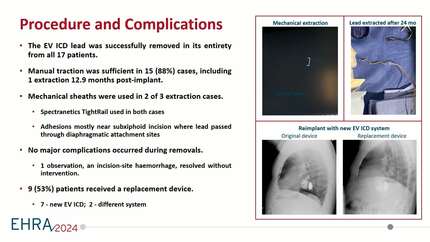
The extravascular implantable cardioverter-defibrillator (EV ICD) has been shown to be safe and effective for patients at risk of sudden cardiac death, but little is known about EV ICD lead removal in humans. This analysis aimed to characterize the EV ICD lead removal experience thus far.
This was a retrospective analysis of lead removals from the EV ICD Pilot, Pivotal, and Continued Access Studies. Patients with a successful EV ICD implant who underwent lead removal were included. The main objective was lead removal success. Ancillary objectives included characterizing technique used, procedure complications, and reimplantation status. An EV ICD system was successfully implanted in 347 patients across the 3 studies (25.9% female; 53.4 ± 13.3 years; left ventricular ejection fraction: 39.7 ± 15.9). Of these patients, 29 (8.4%) underwent lead removal with a mean lead dwell time of 12.6 ± 14.3 months (0.2–58.4). The main reason for lead removal was lead dislodgement (
Complete removal of the EV ICD lead was successful in 93.1% of cases, and simple traction was sufficient in most instances. Based on these results, lead removal from the substernal space was safe and achievable up to 3 years post-implant.
Contributors

Venkata Sagi
Author
Francis Murgatroyd
Author
Lucas V A Boersma
Author
Jaimie Manlucu
Author

Christophe Leclercq
Author
Anish Amin
Author
Joseph Yat Sun Chan
Author
Henri Roukoz
Author

Haris Haqqani
Author
Christopher Wiggenhorn
Author
Thomas R Holmes
Author
Thomas Lulic
Author
Paul Friedman
Author

You may be interested in