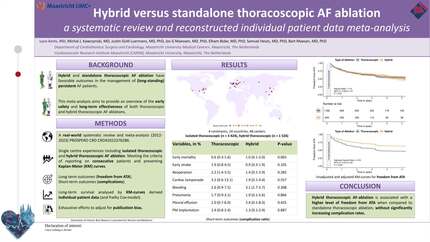
Comparing simultaneous hybrid ablation with stand-alone thoracoscopic surgical ablation for the treatment of non-paroxysmal atrial fibrillation: a prospective randomized controlled trial
EP Europace Journal


Abstract
Advanced atrial fibrillation (AF) is currently a dilemma for electrophysiologists when choosing a minimally invasive treatment strategy. Previous studies have demonstrated the outcome of either catheter ablation or thoracoscopic surgical ablation (SA) is unsatisfactory in these patients. Whether hybrid ablation (HA) could improve outcomes in these patients is unknown. The purpose of this study was to evaluate the clinical efficacy of HA for the treatment of advanced AF.
A randomized controlled trial was designed to enrol patients with persistent AF (PerAF) and enlarged left atrium or long-standing persistent AF (LSPAF) who were randomized to HA or thoracoscopic SA at a 1:1 ratio. The primary endpoint was freedom from any recurrence of AF off antiarrhythmic drugs (AADs) 12 months after operation. The primary endpoint was monitored by 7-day electrocardiogram monitoring devices. One hundred patients were enrolled. The mean age was 58.5 ± 7.6 years, and the mean left atrial diameter (LAD) was 50.1 ± 6.1 mm. At 12 months, freedom from AF off AADs was recorded in 71.4% (35/49) of patients in HA group and 45.8% (22/48) in SA group [odds ratio 2.955, 95% confidence interval (1.275–6.848),
In patients with PerAF and enlarged left atrium or LSPAF, HA achieved better freedom from AF after 1 year of follow-up compared with thoracoscopic SA.
Contributors

Yan Yao
Author
State Key Laboratory of Cardiovascular Disease, Fuwai Hospital, National Center for Cardiovascular D Beijing , China
Haojie Li
Author
Chunyu Yu
Author
Lihui Zheng
Author
Ligang Ding
Author
Lingmin Wu
Author
Sipeng Chen
Author
Hengqiang Lin
Author
Ying Meng
Author
You may be interested in