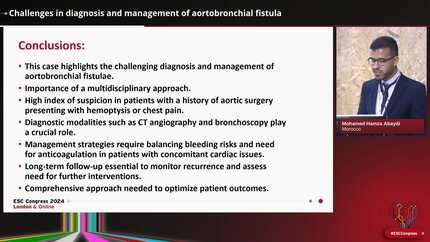
Challenges in diagnosis and management of aortobronchial fistula: a case report
European Heart Journal - Case Reports


Abstract
Aortobronchial fistulas (ABFs) are rare but potentially life-threatening conditions, often presenting with haemoptysis. They can develop following various thoracic aortic conditions or procedures.
A 70-year-old patient with a history of descending aorta replacement and ischaemic stroke presented with chest pain and upper gastrointestinal bleeding. Imaging revealed a fistula between the aortic prosthesis and the lung, along with other cardiovascular abnormalities. Despite the indication for anticoagulant therapy, tranexamic acid was initiated due to bleeding risk. The patient showed clinical improvement with tranexamic acid treatment but experienced recurrence of bleeding after discontinuation. Endovascular treatment for the contained rupture at the proximal stent anastomosis was indicated.
Haemoptysis is the primary symptom of ABFs, often recurring until the fistula enlarges. Postoperative aortic fistulas into the airways are uncommon and can occur years after surgery. Thoracic endovascular aortic repair has become the primary treatment for high-risk patients with thoracic aortic disease. Various diagnostic modalities can visualize a fistula tract, but practical visualization is rare. Untreated ABFs invariably lead to death.
This case highlights the challenges in diagnosing and managing ABFs, emphasizing the need for a multidisciplinary approach and regular follow-up. Patient education and prompt reporting of symptoms are essential. Early intervention upon suspicion of recurrence is crucial for optimizing patient outcomes.
Contributors

Mohamed Hamza Abaydi
Author
Faculty of Medicine and Pharmacy of Tangier - Abdelmalek Essaadi University Tangier , Morocco

Safae Dhimene
Author
Amine Ech-chenbouli
Author
Badre El Boussaadani
Author
Zainab Raissuni
Author
Can Gollmann-Tepeköylü
Author
Nikesh Jathanna
Author
You may be interested in