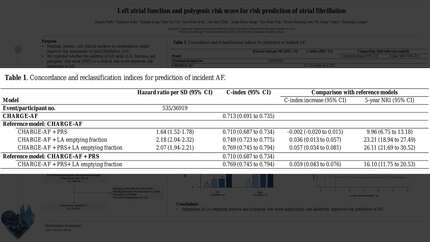
Innovative approaches to atrial fibrillation prediction: should polygenic scores and machine learning be implemented in clinical practice?
EP Europace Journal


Abstract
Atrial fibrillation (AF) prediction and screening are of important clinical interest because of the potential to prevent serious adverse events. Devices capable of detecting short episodes of arrhythmia are now widely available. Although it has recently been suggested that some high-risk patients with AF detected on implantable devices may benefit from anticoagulation, long-term management remains challenging in lower-risk patients and in those with AF detected on monitors or wearable devices as the development of clinically meaningful arrhythmia burden in this group remains unknown. Identification and prediction of clinically relevant AF is therefore of unprecedented importance to the cardiologic community. Family history and underlying genetic markers are important risk factors for AF. Recent studies suggest a good predictive ability of polygenic risk scores, with a possible additive value to clinical AF prediction scores. Artificial intelligence, enabled by the exponentially increasing computing power and digital data sets, has gained traction in the past decade and is of increasing interest in AF prediction using a single or multiple lead sinus rhythm electrocardiogram. Integrating these novel approaches could help predict AF substrate severity, thereby potentially improving the effectiveness of AF screening and personalizing the management of patients presenting with conditions such as embolic stroke of undetermined source or subclinical AF. This review presents current evidence surrounding deep learning and polygenic risk scores in the prediction of incident AF and provides a futuristic outlook on possible ways of implementing these modalities into clinical practice, while considering current limitations and required areas of improvement.
Contributors



You may be interested in