Xylitol is prothrombotic and associated with cardiovascular risk
European Heart Journal


Abstract
The pathways and metabolites that contribute to residual cardiovascular disease risks are unclear. Low-calorie sweeteners are widely used sugar substitutes in processed foods with presumed health benefits. Many low-calorie sweeteners are sugar alcohols that also are produced endogenously, albeit at levels over 1000-fold lower than observed following consumption as a sugar substitute.
Untargeted metabolomics studies were performed on overnight fasting plasma samples in a discovery cohort (
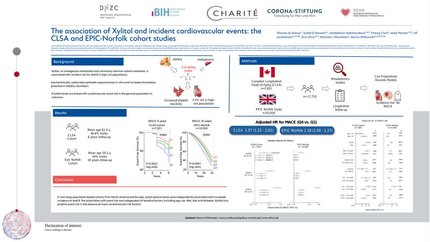
In initial untargeted metabolomics studies (discovery cohort), circulating levels of a polyol tentatively assigned as xylitol were associated with incident (3-year) major adverse cardiovascular event (MACE) risk. Subsequent stable isotope dilution LC-MS/MS analyses (validation cohort) specific for xylitol (and not its structural isomers) confirmed its association with incident MACE risk [third vs. first tertile adjusted hazard ratio (95% confidence interval), 1.57 (1.12–2.21),
Xylitol is associated with incident MACE risk. Moreover, xylitol both enhanced platelet reactivity and thrombosis potential
Contributors

Ina Nemet
Author
Xinmin S Li
Author
Jennifer Wilcox
Author
Marc Ferrell
Author
Hassan Alamri
Author
Nilaksh Gupta
Author
Zeneng Wang
Author
Wai Hong Wilson Tang
Author
You may be interested in