Coexistence of variant-type transthyretin and immunoglobulin light-chain amyloidosis: a case report
European Heart Journal - Case Reports


Abstract
Determining the type of amyloid deposits is clinically important for choosing the specific therapies for cardiac amyloidosis.
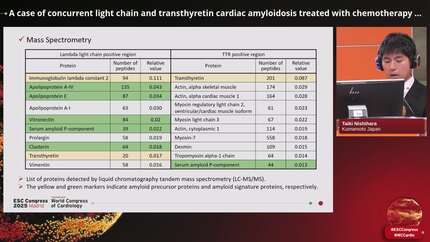
A 78-year-old woman who had been experiencing fluid retention and dyspnoea on exertion for 6 months was referred to our hospital for the management of heart failure with left ventricular hypertrophy. Since 99mTc-hydroxymethylene diphosphonate scintigraphy showed mild cardiac uptake and significant elevation of serum free lambda chain (with a difference of 263 mg/L in free light chain), we suspected immunoglobulin light-chain amyloidosis (AL), and endomyocardial biopsy was performed. The deposit site within the myocardial tissue exhibited positive for Congo red staining and transthyretin immunostaining, however negative or non-specific for light-chain immunostaining including lambda and kappa staining. Genetic testing confirmed a mutation in V122I, variant-type transthyretin amyloidosis (ATTRv). Despite the administration of patisiran, her condition exhibited progressive deterioration. Additionally, she displayed macroglossia, an atypical manifestation in ATTRv amyloidosis. Further biopsies from tongue and abdominal wall fat culminated in a final diagnosis: the coexistence of ATTRv and AL (of the lambda type). Although treatment with melphalan and dexamethasone was started, she passed away 24 months after the initial visit. When the endomyocardial biopsy specimen underwent mass spectrometry as a
Coexistence of ATTRv and AL within cardiac amyloidosis is extremely uncommon. In situations where incongruities arise between the amyloid type determined via immunohistochemistry findings and the amyloid type assumed based on other clinical findings, mass spectrometry should be considered.
Contributors

Yuko Eda
Author
Suzuho Onagi
Author
Nagaaki Katoh
Author

Valentina Rossi
Author
Tiziana Felice
Author
Raheel Ahmed
Author
Laura Verga
Author
Ralph Mark Louis Neijenhuis
Author
You may be interested in