Arrhythmogenic cardiomyopathy related phenotypes are detected and pharmacologically modulated in Galectin-3 zebrafish models
Cardiovascular Research


Abstract
Type of funding sources: Public grant(s) – National budget only. Main funding source(s): Italian Ministry of University and Research
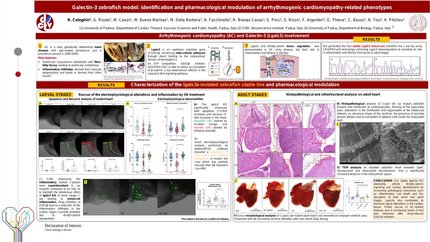
Arrhythmogenic Cardiomyopathy (AC) is a rare inherited cardiac disorder characterized by fibro-fatty replacement and progressive loss of the ventricular myocardium, causing life-threatening arrhythmias, syncope and sudden cardiac death in young and athletes. About 50% of AC cases carry one or more mutations in genes encoding for desmosomal proteins. However, mutations in non-desmosomal genes have been identified in 1-3% of AC patients, such as Galectin-3 (Gal-3).
For a better understanding of Gal-3 role in AC pathogenesis, we have generated a stable Gal-3 knock-out (KO) zebrafish line, able to reproduce cardiac abnormalities and cell signaling dysregulation characteristic of AC, on which environmental factors and candidate drugs can be tested.
The zebrafish Gal-3 mutant line was generated by CRISPR/Cas9 strategy and then phenotypically characterized. Phenotyping included heart activity characterization, by pyHeart4Fish software, and gene expression analysis using Real Time PCR and signaling pathway reporters. Immunofluorescence analysis was performed using an antibody against L-plastin, a leukocyte marker for the detection of inflammatory cells, and Acridine Orange/Ethidium Bromide (AO/EB) staining to check for apoptotic and necrotic events. Transmission Electron Microscopy (TEM) analysis was carried out to detect possible ultrastructural alterations. A pathway-directed pharmacological treatment was applied to try to rescue pathological phenotypes.
The Gal-3 KO zebrafish line, analysed at larval stage, presented structural abnormalities, pericardial effusion and/or hemopericardium associated with reduced contractility, bradycardia and presence of arrhythmia events. In addition to Wnt/β-catenin signaling dysregulation, as seen in other AC forms, we also observed cell death and inflammation. Specifically, the analysis of the L-plastin inflammatory marker showed remarkable infiltration of inflammatory cells in the cardiac region of Gal-3 mutants, whereas AO/EB staining demonstrated elevated number of apoptotic and necrotic cells. Moreover, TEM analysis revealed "pale", disorganized and delocalized desmosomes in mutant adult hearts. Of note, pharmacological treatment at larval stage, using a Wnt/β-catenin signaling agonist, partially rescued a set of AC cardiac phenotypes (contractility, bradycardia, arrhythmia).
Overall, the Gal-3 KO zebrafish line confirms in zebrafish the strict connection between Gal-3 mutation and AC-like cardiac alterations. Moreover, cell death and inflammation, known to be involved in the remodelling of the myocardium, were observed. The pharmacological rescue of the Wnt/β-catenin signaling partially recovered a set of cardiac phenotypes, confirming this pathway as a key modulator of AC progression. In conclusion, our results strongly support the usefulness of the Gal-3 zebrafish mutant to clarify Gal-3 involvement in AC, offering future perspectives for AC treatment.
Contributors

R Celeghin
Author
G Beffagna
Author
M Cason
Author
M Bueno Marinas
Author
M Della Barbera
Author
N Facchinello
Author
R Branas Casas
Author
S Rizzo
Author
F Argenton
Author
G Thiene
Author

K Pilichou
Author
C Basso
Author
You may be interested in