Flecainide to prevent atrial arrhythmia after patent foramen ovale closure, Rationale and design of the randomized AFLOAT study
European Heart Journal - Cardiovascular Pharmacotherapy


Abstract
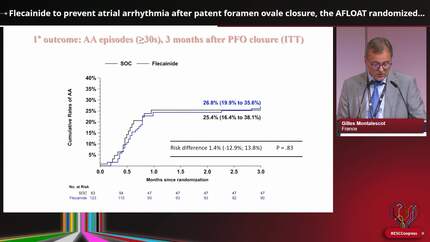
Atrial arrhythmia is the most common complication of patent foramen ovale (PFO) closure. The real incidence of post-PFO closure atrial arrhytmia and whether this complication can be prevented is unknown.
The Assessment of Flecainide to Lower the PFO closure risk of Atrial fibrillation or Tachycardia (AFLOAT) trial is a prospective, national, multicentre, randomized, open-label, superiority trial with a blind evaluation of all the endpoints (PROBE design). A total of 186 patients are randomized in a 1:1:1 ratio immediately after PFO closure to receive Flecainide (150 mg per day in a single sustained-release (SR) dose) for 6 months (Group 1), Flecainide (150 mg per day in a single SR dose) for 3 months (Group 2), or no additional treatment (standard of care) for 6 months (Group 3). The primary endpoint is the percentage of patients with at least one episode of symptomatic or asymptomatic atrial arrhythmia episode (≥30 s) recorded within 3 months after PFO closure on long-term monitoring with an insertable cardiac monitor. Whether 3 months of treatment is sufficient compared to 6 months will be analysed as a secondary objective of the study.
AFLOAT is the first trial to test the hypothesis that a short treatment with oral Flecainide can prevent the new-onset of atrial arrhythmia after PFO closure.
NCT05213104 (
Contributors

Marie Hauguel-Moreau
Author
Paul Guedeney
Author
Claire Dauphin
Author
Vincent Auffret
Author
Eloi Marijon
Author
Philippe Aldebert
Author
Jean-Michel Clerc
Author

Meyer Elbaz
Author
Wissam Abi Khalil
Author
Antoine Da Costa
Author
Jean-Christophe Macia
Author
Simon Elhadad
Author
Guillaume Cayla
Author
Delphine Brugier
Author
Johanne Silvain
Author
Nadjib Hammoudi
Author
Guillaume Duthoit
Author
Eric Vicaut
Author
Gilles Montalescot
Author
Marie Hauguel-Moreau
Author
Guillaume Duthoit
Author
Eric Vicaut
Author
Mikael Laredo
Author
Thomas Rolland
Author
Yassine Temmar
Author
Nicolas Lellouche
Author
Gilles Chatellier
Author
Stéphane Edhery
Author
Gilles Montalescot
Author
Claire Dauphin
Author
Vincent Auffret
Author
Eloi Marijon
Author
Farzin Beygui
Author
Philippe Aldebert
Author
Jean-Michel Clerc
Author
Meyer Elbaz
Author
Jean-Christophe Macia
Author
Antoine Da Costa
Author
Wissam Abi Khalil
Author
Simon Elhadad
Author
Guillaume Cayla
Author
Xavier Iriart
Author
You may be interested in