Low-dose dexmedetomidine sedation in patients undergoing electrophysiological study and ablation of supraventricular tachycardias in a same day setting
EP Europace Journal


Abstract
Catheter ablation for supraventricular tachycardias (SVT) can frequently cause patient discomfort, anxiety or pain. Through the years different drugs have been employed to provide an optimal sedation without interfere with inducibility of tachyarrhythmia. Moreover, the increasing number of patients with this clinical condition and the growing demand of catheter ablation, makes same day discharge mandatory. For this purpose, drugs that guarantee minimal sedation and reduce adverse events should be used. Dexedetomidine (DEX) is a selective alpha-2 agonist with analgesic and sedating effect without significant respiratory depression. Its electrophysiological effects include the sinus node and atrioventricular (AV) node depression and an increased atrial refractoriness. Albeit there is a reduction of side effects of most commonly used sedation drugs, data on the efficacy and safety profile of DEX during SVT ablation of adult patients are unclear and conflicting.
The aim of this study was to assess whether optimal sedation and patient’s comfort can be achieved with a low-dose DEX without interfering with electrophysiological parameters during catheter ablation of SVT in adult population.
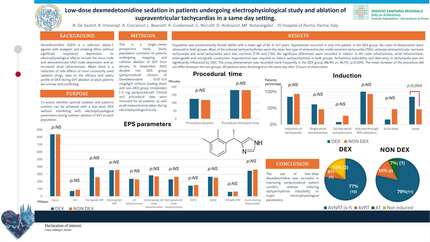
This is a single-center prospective study. Study population consisted of patients undergoing mapping and catheter ablation of SVT from January to September 2023 divided into DEX group (periprocedural infusion of Dexedetomidine 0.07-0.11 mcg/kg/h without loading dose) and non-DEX group (midazolam 1-2 mg periprocedural). Clinical and procedural data were recorded for all patients, as well as all measurements taken during electrophysiological study.
The study population was predominantly female (60%) with a mean age of 56 ± 13.7 years. Hypotension occurred in only one patient, in the DEX group. No cases of desaturation were observed in both groups. Most of the induced tachyarrhythmias were the slow-fast type of atrioventricular nodal reentrant tachycardia (75%), whereas atrioventricular reentrant tachycardia and atrial tachycardia were less common (7.1% and 7.1%). No significant differences were recorded in relation to AV node refractoriness, atrial refractoriness, anterograde and retrograde conduction. (Table 1) Isoproterenol was required to induce tachyarrhythmia in both groups. Arrhythmia inducibility and aberrancy in tachycardia was not significantly influenced by DEX. The jump phenomenon was recorded more frequently in the DEX group (86.4% vs. 46.7%; p=0.004). The mean duration of the procedure did not differ between the two groups. All patients were discharged on the same day after 3 hours of observation.
The use of low-dose Dexedetomidine was succesful in improving periprocedural patient comfort, without reducing tachyarrhythmia inducibility or major electrophysiological parameters.
Contributors

R Vrenozaj
Author
A Crocamo
Author
L Bearzot
Author
A Guidorossi
Author
G Niccoli
Author
D Ardissino
Author
M F Notarangelo
Author
You may be interested in