Electrocardiographic characteristics and catheter ablation of premature ventricular complex- mediated ventricular fibrillation
EP Europace Journal


Abstract
Premature ventricular contractions (PVCs) can trigger ventricular fibrillation (VF) in patients with/or without structural heart disease. There are limited data on coexisting electrocardiographic (ECG) features and catheter ablation outcomes in these patients which could suggest the concomitant presence of an abnormal electrical and structural substrate.
We investigated ECG and electroanatomic characteristics and clinical outcomes in patents who underwent catheter ablation of PVCs triggering VF.
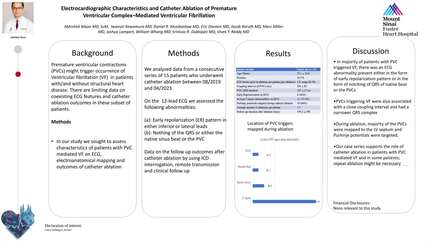
We analyzed data from a consecutive series of patients who underwent catheter ablation between 08/2019 and 04/2023 for PVCs triggering VF. On the 12-lead ECG, we assessed the following abnormalities: (a) Early repolarization (ER) pattern in either inferior or lateral leads (Figure 1), or (b) QRS Notching of either the native sinus beat or PVC (Figure 2). Post-ablation follow up outcomes were collected using a combination of ICD interrogation, remote transmission and clinical follow up.
The cohort included 15 patients: age 52.1±16.8 years, 46.7% females, and 26.7% presenting with VF storm. On average, there were 3.8 HV shocks/per patient from an ICD prior to the index ablation procedure (range: 0-19 shocks). On the 12-lead ECG, the mean coupling interval of the PVC leading to VF was 204±82 ms, and an overall narrow PVC morphology with a mean QRS duration of 107±17 ms. We observed early repolarization (ER) in 6 (40%) of the cohort. In most patients (n=11; 73.3%), at least one of the 2 ECG abnormalities were present. An endocardial-only approach was adequate in all patients, and during catheter ablation, Purkinje potentials were targeted in 10 (66%) of the patients.
Based on activation and pace-mapping, the PVCs were localized to the following sites: (a) left ventricular (LV) septum in 11 (73.3%), (b) papillary muscles in 2 (13.3%), and (c) other sites such as the Moderator band and right ventricular outflow tract in the remaining 2 (13.3%) patients. The ablation locations on the LV septum extended from basal to mid-septum. After an average of 1.7 ablation procedures targeting PVC-triggering VF, 12 (80%) patients remained free of sustained ventricular arrhythmias and ICD shocks, over a mean follow up of 479±395 days.
In most patients with PVCs-triggering VF, there was an evidence of an ECG abnormality either in the form of an ER pattern or notching of either the Sinus QRS or the PVC complex on pre-ablation ECG. During ablation, Purkinje potentials and PVCs were mapped to and ablated in the region of the LV interventricular septum and papillary muscles. Over long-term follow up, catheter ablation seemed durable and effective in reducing VF episodes and ICD shocks. Presence of Early Repolarization pattern Presence of a notching pattern in the Si
Contributors


I K Iwanari Kawamura
Author
E S Stanton
Author
M M Miller
Author
J L Lampert
Author
W W Whang
Author

You may be interested in