Key influences of VDD (DX) ICD selection: results from a prospective, national survey
EP Europace Journal


Abstract
To preserve the benefit of atrial sensing without the implantation of an additional lead, a single-lead ICD system with a floating atrial dipole (VDD or DX ICD) has been developed.
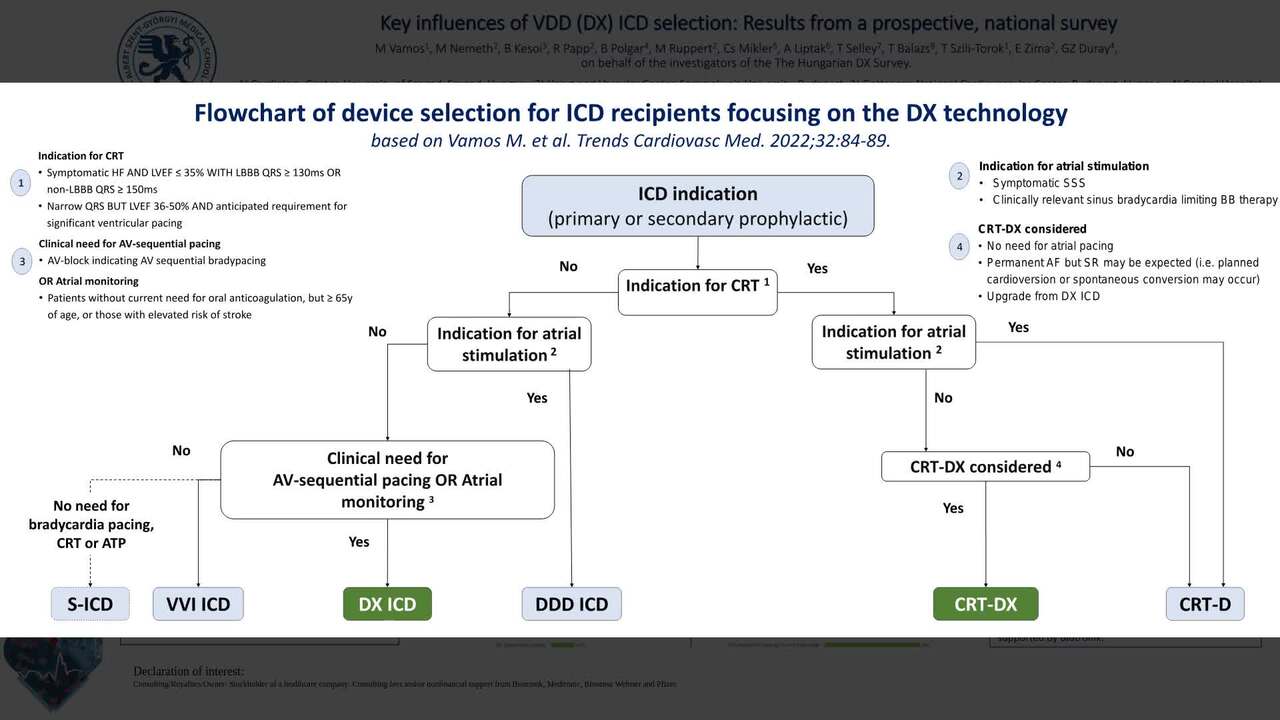
The purpose of this nationwide survey was to provide an overview of the current key influences of device selection focusing on DX ICD systems and to test the applicability of a previously published decision-making flowchart of ICD type selection in the daily clinical practice.
An online questionnaire was sent to all implanting centers in Hungary. In total, 10 centers participated in the survey and reported data from 361 DX ICD and 10 CRT-DX systems implantations between February 2021 and May 2023.
The most important influencing clinical factors indicated by the participating doctors were elevated risk of atrial fibrillation/stroke (56%), risk of sinus/supraventricular tachycardias (42%), and a potential need for CRT upgrade in the future (36%). The DX ICD was considered in the majority of cases instead of the VVI system (87%), and only in a small proportion instead of a DDD ICD (13%). 60% of the patients with DX ICDs were also included into remote monitoring-based follow-up. In 83% of the cases, good (>2 mV) or excellent (>5) atrial signal amplitude was recorded within 6 weeks after the implantation.
In the current nationwide survey, the most important influencing clinical factors indicated by the responding doctors for selecting a DX ICD were the elevated risk of stroke or sinus/supraventricular tachycardias and a potential need for CRT upgrade in the future. These findings support the use of a previously published decision-making flowchart. Graphical abstract
Contributors



R Papp
Author
B Polgar
Author
M Ruppert
Author
C S Mikler
Author
A Liptak
Author
T Selley
Author
T Balazs
Author
T Szili-Torok
Author
E Zima
Author
G Duray
Author
You may be interested in