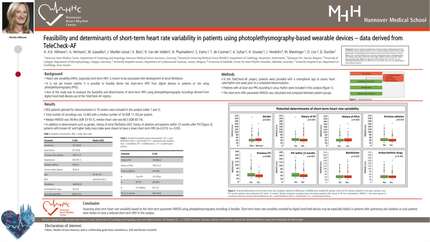
Feasibility and determinants of short-term heart rate variability in patients using photoplethysmography-based wearable devices - data derived from TeleCheck-AF
EP Europace Journal


Abstract
Heart rate variability (HRV), especially short-term HRV, is known to be associated with development of atrial fibrillation (AF). Nevertheless, it is not known if short-term HRV can be feasibly derived from digital devices in patients at risk for AF. In this analysis, we aimed to evaluate the feasibility and determinants of short-term HRV using non-continuous photoplethysmography (PPG) recordings derived from digital hand-held device.
TeleCheck-AF is a project implementing an on-demand app-based infrastructure for the management of AF. Briefly, one week prior to the scheduled teleconsultation, patients were provided with a smartphone app to assess heart rate/rhythm three times a day and in case of symptoms. Patients from the project with at least one PPG recording in sinus rhythm (SR) during the study period were analyzed. For every recording in SR, the short-term HRV parameter, root mean square of successive normal-to-normal interval differences (RMSSD), was calculated. The PPG parameters, heart rate and RMSSD, were compared between groups (men vs women, presence vs absence of previous AF, atrial flutter, atrial tachycardia, pulmonary vein isolation (PVI) within 12 months).
Overall, 855 patients [60.5% men, median age 63 (56;70) years] with a total number of 13465 recordings were included in the analysis. Median number of recordings per patient was 15 (7;20) with a median heart rate of 66 (59;75)bpm and a RMSSD of 39.7 (30.6 ;56.1)ms. Results revealed a significant difference in RMSSD for gender and previously known AF, whereas no difference was seen e.g., for patients with known atrial flutter or atrial tachycardia (table 1). In patients with previously known AF, patients who underwent PVI within the last 12 months had a reduced RMSSD in comparison to patients without previous PVI (36.7 (31.8; 47.0)ms vs 42.2 (34.4; 54.3)ms, p<0.001).
Assessing short-term HRV based on RMSSD using PPG recordings is feasible. Short-term HRV recorded by digital hand-held devices may be especially helpful in patients after PVI as such patients were shown to have a reduced HRV in this analysis.
Table 1: Differences in short-term heart rate variability in patients at risk for atrial fibrillation. AF = Atrial fibrillation.
Contributors


A Hermans
Author
M Gawalko
Author
J Mueller-Leisse
Author
K Betz
Author
R Van Der Velden
Author
N Pluymaekers
Author
S Evens
Author
T De Cooman
Author
A Sultan
Author
H Gruwez
Author
J Hendriks
Author
M Manninger
Author
D Linz
Author

You may be interested in