Non-invasive detection of cardiac arrhythmias using photoplethysmography signals
EP Europace Journal


Abstract
Cardiac arrhythmias (CAs) are associated with critical heart-related complications such as stroke or heart failure. Because of the intermittent and asymptomatic presentation of some CAs in their early stages, the screening remains limited using traditional methods based on ECG. Recent advances in photoplethysmography (PPG) have revealed substantial potential for wearable devices to detect CAs within large populations. Although PPG has demonstrated efficiency in discriminating atrial fibrillation (AF) from normal sinus rhythm, it remains unclear whether AF detection methods remains effective in the presence of CAs other than AF.
In this study, we applied a recurrent neural network on a dataset containing eight different types of CAs (Table 1). The classifier processes sequences of interbeat intervals (IBIs) as input and discriminates between normal and abnormal rhythms. The algorithm was evaluated on 64 patients (45 males and 19 females , with a mean age of 55.9 ± 16.0) undergoing a diagnostic or therapeutic electrophysiological procedure. This dataset includes simultaneous recordings of PPG signals from a wrist-bracelet and 12-lead ECG, with the latter used as the gold-standard for annotating cardiac rhythms.
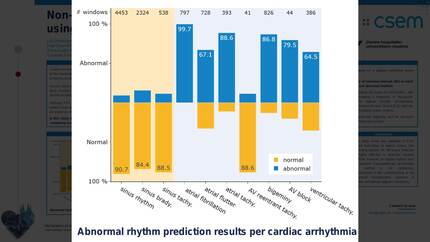
The classifier achieved 84% accuracy, 77% sensitivity and 88% specificity in detecting abnormal rhythms. Table 1 shows that AF (99.6%), atrial tachycardia (100%) and AVRT (96.4%) were well classified as abnormal rhythm, whereas the reliability of the detection decreased for atrial flutter (65.4%), atrial or ventricular bigeminy (72.4%) and ventricular tachycardia (80.2%). Undetected abnormal rhythms were often characterized by a rather regular rhythm (illustrated by VT in Figure 1) and CAs for which PPG heartbeat detection was initially not optimal (Bigeminy in Figure 1).
In conclusion, this study shows the capability of PPG-based technology to detect various CAs extending beyond AF. It highlights the merits and limitations of IBI-based detection of abnormal rhythms, highlighting the need for a better comprehension of the peripheral hemodynamic signature of CAs.
Contributors

J Van Zaen
Author
M Le Bloa
Author
C Teres
Author
C Herrera
Author

G Domenichini
Author
J P Thiran
Author
M Lemay
Author
F Braun
Author
You may be interested in