Artificial Intelligence-based Electrocardiogram prediction for duration of Atrial Fibrillation
EP Europace Journal


Abstract
Atrial fibrillation (AF) is the most common sustained arrhythmia and is associated with poor clinical outcomes, including stroke, acute coronary events, and heart failure. Recent studies have shown that early rhythm treatment of new-onset atrial fibrillation improves the patient's prognosis. However, atrial fibrillation is often asymptomatic, and it is difficult to determine its duration accurately. Recently, AI-bsed ECG has been studied for various cardiovascular diseases.
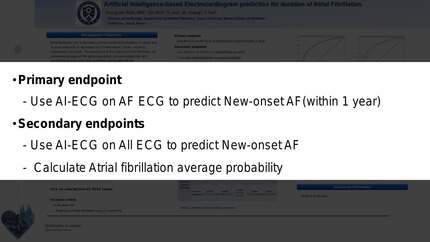
We sought to develop and validate a predictive model of the ECG for the duration of atrial fibrillation.
All patients aged 18 years older with at least one ECG were included in the study. Only patients with sinus rhythm with ECG prior to atrial fibrillation with ECG were selected. An ECG within 1 year from AF was first documented in ECG was defined as new onset AF. After dividing our datasets into training (and test sets, we developed an end-to-end deep neural network to predict for the duration of AF. Performance evaluation was conducted using various metrics, including AUROC, AUPRC, sensitivity, specificity, F1 score.
The dataset consisted of 83,525 ECGs from 16,193 patients from two hospitals. The AUROC for discriminating old AF and new-onset AF is 0.8186 (0.8181 - 0.8190) on internal validation set and 0.7967 (0.7966 - 0.7969) on external validation set. Sensitivity, Specificity, and F1 score are 0.7126((0.7118-0.7134), 0.7697 (0.7693-0.7701) and 0.5751 (0.5745-0.5757) on internal validation set and 0.7309 (0.7307-0.7311), 0.7225 (0.7224-0.7227) and 0.6354 (0.6352-0.6356)on external validation set.
Our deep learning model can be used to predict atrial fibrillation's duration. Additional studies are ongoing to understand the relative importance of ECG features.

You may be interested in