Artificial intelligence-estimated electrocardiographic age as a recurrence predictor after atrial fibrillation catheter ablations
EP Europace Journal


Abstract
The application of artificial intelligence (AI) algorithms to 12-lead electrocardiogram (ECG) provides promising age prediction models. We explored whether the gap between the pre-procedural AI-ECG age and chronological age can predict atrial fibrillation (AF) recurrence after catheter ablation.
We validated a pre-trained residual network (ResNet)-based model for age prediction on four independent multinational datasets: CODE-15%, PTB-XL, UK Biobank, and SaMi-Trop cohorts. Then, we evaluated AI-estimated ECG (AI-ECG) age for AF recurrence in a single-center AF catheter ablation (AFCA) cohort, which included 4,794 patients with de-novo AFCA and pre-procedural sinus rhythm ECGs. We categorized the AI-ECG age gap into two groups: aged-ECG (>13 year) and normal age (≤13 year) groups based on the maximum log-likelihood for AF recurrence according to the difference between chronological age and AI-ECG age.
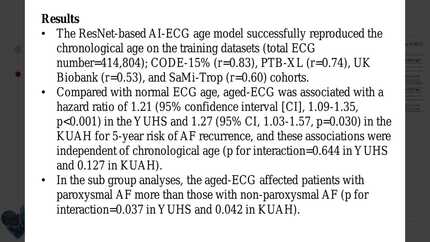
The ResNet-based AI-ECG age model successfully reproduced the chronological age on the independent datasets (total ECG number=414,804): CODE-15% (r=0.83), PTB-XL (r=0.74), UK Biobank (r=0.53), and SaMi-Trop (r=0.60). During median 22 (9-47) months after AFCA, patients with aged-ECG had a significantly higher AF recurrence rate (adjusted hazard ratio 1.31, 95% confidence interval [1.17-1.48], p<0.001) than normal age group. In the sub-group analyses, the aged-ECG affected more in patients with paroxysmal AF than in non-paroxysmal AF (P for interactions <0.001) and after cryoballoon pulmonary vein isolation (Cryo-PVI) than radiofrequency PVI (P for interactions <0.001).
Pre-procedural AI- ECG age has a prognostic value for AF recurrence after AF catheter ablation.
Contributors

H Park
Author
Severance Cardiovascular Hospital, Yonsei University College of Medicine Seoul , Korea (Republic of)

D H Kim
Author
Severance Cardiovascular Hospital, Yonsei University College of Medicine Seoul , Korea (Republic of)

J W Park
Author
Yonsei University College of Medicine, Yonsei University Health System Yongin , Korea (Republic of)
H T Yu
Author
Severance Cardiovascular Hospital, Yonsei University College of Medicine Seoul , Korea (Republic of)
T H Kim
Author
Severance Hospital, Yonsei University College of Medicine Seoul , Korea (Republic of)


You may be interested in