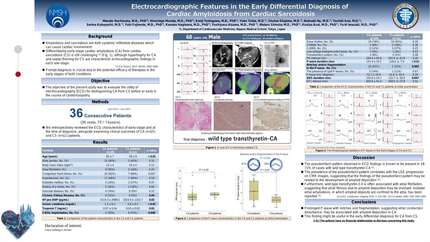
Electrocardiographic features in the early differential diagnosis of cardiac amyloidosis from cardiac sarcoidosis
EP Europace Journal


Abstract
Amyloidosis and sarcoidosis are both systemic infiltrative diseases which can cause cardiac involvement. Differentiating early-stage cardiac amyloidosis (CA) from cardiac sarcoidosis (CS) is still challenging, although hypertrophy for CA and septal thinning for CS are characteristic echocardiographic findings in each late-stage. The diagnosis is a time-sensitive issue, given the therapies for CA and CS likely to be effective at early disease stages.
We aimed to evaluate the utility of electrocardiography (ECG) for distinguishing CA from CS before or early in the course of cardiomyopathy.
This study enrolled 36 consecutive patients (20 male, 75±13 years) diagnosed with transthyretin-CA in 25 (CA group) and isolated CS in 11 patients (CS group) according to accepted criteria at our institute from July 2014 to July 2023. We retrospectively reviewed electrocardiographic characteristics and clinical outcomes of early-stage CA and CS.
The CS group were younger than the CA group at the time of diagnosis (59±9 vs 83±7 years, P<0.01) and had a shorter period between the date of their first ECG recording at our institute and the date of diagnosis (18±3 vs 62±67 months, P=0.012). Furthermore, the CA group showed specific P-waves with longer duration (142±19 vs 126±8 ms, P=0.003) and more notches and/or fragmentation (91% vs 33%, P=0.003) in the limb leads on the initial ECG than the CS group, although prolonged PR-interval is common in both CA and CS (191±44 vs. 208±43 ms, P=0.359). Unexpectedly, the CA group had a shorter QRS duration (103±25 vs 123±31 ms, P=0.047) and a higher R-wave in V5 (2.0±0.9 vs 1.3±1.1 mV, P=0.039) than the CS group. In addition, the low voltage in all limb leads, pseudoinfarct pattern and bundle branch block morphology characteristic of CA patients did not differ between diagnosis and initial examination. There were also no differences in atrial and ventricular arrhythmias. During the follow-up period, 5 patients (20%) in the CA group, but no patients in the CS group died.
CA and CS shares several electrocardiographic features. Prolonged P-wave with notches and fragmentation, suggesting atrial conduction disturbance, may be associated with amyloid deposition in CA. This finding might be useful in the early differential diagnosis for CA from CS.
Contributors

K Yodogawa
Author
Y Toida
Author
N Ito
Author
T Arai
Author
S Kobayashi
Author
K Hagiwara
Author
Y Aizawa
Author

You may be interested in