Clinical impact of ICD implantation in octogenarians: a longitudinal cohort study
EP Europace Journal


Abstract
The implantation of defibrillators (ICDs) in patients over 80 years old is becoming increasingly common; however, evidence-based data regarding the actual clinical benefit in this population remain limited and contradictory. While age seems not to affect mortality and arrhythmia risk in octogenarians undergoing secondary prevention, the mortality reduction benefit given by ICD implantation for primary prevention appears to decrease with advancing age, likely due to the high number of non-arrhythmic deaths.
This study aims to assess the long-term incidence of ventricular arrhythmias and mortality in a real-world cohort of octogenarian patients undergoing ICD implants.
This was an observational, retrospective, longitudinal cohort study. Demographic, clinical, and radiological data were collected for all patients undergoing ICD implantation between 2014 and 2021. Deaths from all causes and significant arrhythmic events (sustained ventricular tachycardias and ventricular fibrillation) detected during routine device controls and remote monitoring were recorded. Then was performed an univariate Kaplan-Meier analysis, stratifying the population by age in relation to the two study endpoints: ventricular arrhythmias and all-cause mortality.
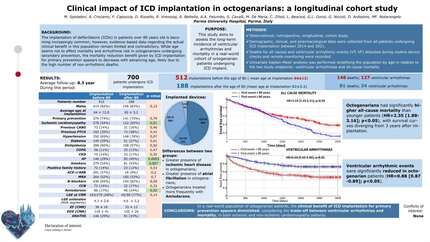
Out of a total of 700 patients, 512 underwent ICD implantation before the age of 80 (mean age at implantation 64±12), while 188 underwent ICD implantation after the age of 80 (mean age at implantation 82±3.2). No significant differences were found between these two groups in terms of gender (82% vs. 83% male; p 0.12), indication for implantation (74% vs. 75% primary prevention; p 0.79), and the presence of late gadolinium enhancement (LGE) on cardiac MRI (68% vs. 77%; p 0.14). Octogenarians were more frequently affected by ischemic heart disease (54% vs. 65%; p 0.01) and were more frequently treated with Amiodarone (17% vs. 24%; p 0.02). At the end of the average 8-year follow-up, octogenarians had significantly higher all-cause mortality than younger patients (HR=2.35 [1.88-3.16]; p<0.05), with survival curves diverging from 3 years after implantation. However, ventricular arrhythmic events were significantly reduced in octogenarian patients (HR=0.88 [0.87-0.89]; p<0.05).
In a real-world population of octogenarian patients, the clinical benefit of ICD implantation for primary prevention appears diminished, considering the trade-off between ventricular arrhythmias and mortality, in both ischemic and non-ischemic cardiomyopathy patients.
Contributors

A Crocamo
Author
F Capoccia
Author
D Rizzello
Author
R Vrenozaj
Author
A Bettella
Author
A A Palumbo
Author
S Cavalli
Author
M De Maria
Author
C Zilioli
Author
L Bearzot
Author
G L Gonzi
Author
D Ardissino
Author
M F Notarangelo
Author
You may be interested in