Impact of gender on the utilisation implantable cardioverter defibrillators and outcome: results from the German DEVICE registry
EP Europace Journal


Abstract
Implantable cardioverter defibrillators (ICD) are an established therapy for the primary and secondary prevention of sudden cardiac death. Real world data regarding the impact of gender on ICD implantation and outcome are scarce.
To determine the impact of gender on the ICD implantation and outcome.
The German DEVICE registry is a prospective, nationwide database of ICD and CRT devices implantation and revisions. Between March 2007 and February 2014, 3794 patients undergoing a single or dual chamber ICD implantation and revisions were prospectively included in 44 centres and monitored for a median of 17 months. Herein we conducted the gender-based analysis of the ICD recipients.
A total of 688 (18,1%) women (mean age 62.5 ± 16.0, median BMI 26.7) and 3106 men (mean age 64.6 ± 12.9, median BMI 26.8) were included in this registry. Significantly less women had coronary artery disease (p<0.001), while more women had hypertrophic cardiomyopathy (p=0.024) and primary electrical heart disease (p<0.001), mainly because of a higher incidence of long QT syndrome and arrhythmogenic right ventricular cardiomyopathy.
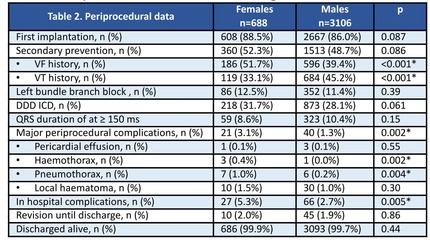
There was a trend towards a higher rate dual chamber ICD in the female population (31.7% vs. 28.1%; p=0.061). Women were less likely to undergo ambulatory interventions (6.4% vs. 9.0%; p=0.026) and had a trend towards higher rate of ICD implantation for secondary prevention (52.3% vs. 48.7%; p=0.086). Females were more likely to have a history of ventricular fibrillation (51.7% vs. 39.4%; p<0.001) and resuscitation (54.7% vs. 46.3%; p=0.006), but less likely to have a history of ventricular tachycardia (33.1% vs. 45.2%; p<0.001). The overall rate of in-hospital complications (5.3% vs. 2.7%; p=0.005) as well as the rate of major periprocedural complications (3.1% vs. 1.3%; p=0.002) was significantly higher among females, mainly driven by a higher incidence of pneumothorax (1.0% vs. 0.1%; p=0.004) and haemothorax (0.4% vs. 0%; p=0.02). The rate of in-hospital device revision and mortality were similar between genders. The Kaplan-Meier estimated 1-year all-cause mortality was 5.2% for women and 7.1% for men (p=0.073; Fig 1), while the estimated incidence of all-cause mortality or device shocks was significantly lower in the female population (15.1% vs. 19.0%; p=0.02). Women were more likely to undergo resuscitation during follow-up (FU; 1.3% vs. 0.3%; p<0.001) and showed a higher fear of receiving device shocks. There was no difference in terms of ICD-shocks, VT-storm and ablation rates at FU. The all- cause, device-related, and other cardiovascular rehospitalisation rates and the incidence of non-arrhythmic adverse events during FU were similar between genders.
In this real-life patient cohort only a minority of patients were females. Female patients had a higher risk of major periprocedural complications and in-hospital complications and a trend towards a lower all-cause mortality during FU. Fig 1. Kaplan-Meier estimated survival.
Contributors




You may be interested in