AV synchrony maintained by a dual-chamber leadless pacemaker in real-world conditions
EP Europace Journal


Abstract
A dual-chamber leadless pacemaker system has been developed to provide atrial and ventricular pacing and maintain atrioventricular (AV) synchrony. The device demonstrated an ability to maintain consistent AV synchrony in an in-clinic setting when tested through a series of postures and gaits under some programming restrictions. Assessing AV synchrony within real-world conditions is needed to understand the device’s performance under wider variations in activity and over a longer period.
Assess a dual-chamber leadless pacemaker’s ability to maintain AV synchrony in an ambulatory environment of daily living under clinically driven programmed settings.
Implanted de novo subjects, who had at least 25% atrial pacing after 3-months post-implant, wore a 12-lead Holter monitor for a minimum of 24 hours during normal daily activities and completed a symptom diary. Devices were programmed to a dual chamber pacing mode and clinically appropriate settings then interrogated pre- and post-assessment. An independent Core Laboratory evaluated AV Synchrony, based on a configurable sampling window approach at repeated intervals, and defined synchronous cycles based on whether PR intervals fell within a 50 ms margin of the programmed Paced AV Delay.
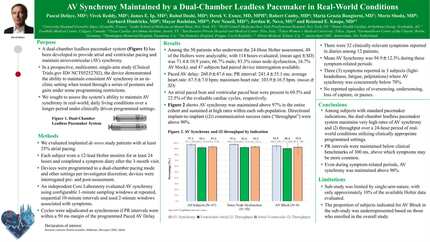
Among the 50 subjects who were administered the assessment, 48 of their Holters were analyzable (mean age 71.4 ± 10.9 years; 66.7% male), and 47 subjects had paired device interrogation data available. The analyzable population was predominantly indicated for sinus node dysfunction (83.3%) with a minority indicated for AV block (16.7%). The mean ± standard deviation of the programmed paced AV delay was 260.0 ± 47.6 ms, and mean PR interval was 241.4 ± 35.1 ms. An atrial paced beat and ventricular paced beat were each present in 69.5% and 22.5% of the evaluable cardiac cycles in the population, respectively. Mean AV Synchrony was maintained above 97% (95% CI: 95.5, 98.8) in the entire cohort and was sustained at high rates within each sub-population. Device metrics that diagnose the rate of directional implant-to-implant (i2i) communication also confirmed device data average throughput rates above 90% (Picture 1). There were no reported episodes of oversensing, undersensing, loss of capture, or pauses.
Among subjects with standard pacemaker indications, the dual-chamber leadless pacemaker system maintains very high rates of AV synchrony, exceeding i2i throughput, within real-world conditions utilizing clinically appropriate programmed settings. AV Synchrony and i2i by Indication





You may be interested in