Long-term outcomes in hybrid versus standalone thoracoscopic ablation in patients with atrial fibrillation: a systematic review and reconstructed individual patient data meta-analysis
EP Europace Journal


Abstract
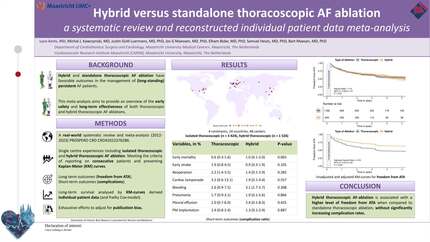
Both hybrid and standalone thoracoscopic atrial fibrillation (AF) ablation techniques have demonstrated favorable outcomes in the management of (long-standing) persistent AF patients, as compared to catheter ablation. However, it is currently unknown whether there is a difference in long-term freedom from AF when comparing these two procedures.
To compare long-term freedom from atrial tachyarrhythmias (ATA) in patients undergoing hybrid and standalone thoracoscopic AF ablation.
A systematic search encompassing PubMed, EMBASE, and the Cochrane Library databases from January 1, 2012, to September 6, 2023, was performed using the following search terms: 'thoracoscopic ablation,' 'hybrid ablation,' 'atrial fibrillation,' and various alternative spellings. Articles were included for pooled analysis of freedom from ATA after meeting the criteria of reporting on consecutive patients and presenting Kaplan-Meier (KM) curves. Individual time-to-event data were reconstructed from the KM curves and included in a multivariable Cox and frailty Cox model with adjustments for age, sex, type of AF, AF duration, and study (frailty term in the frailty Cox model).
In total, 18 studies were included in the meta-analysis for long-term freedom from ATA, comprising 2215 patients. Patients undergoing hybrid thoracoscopic ablation were older (62.0 vs. 58.8 years old, p=0.046), had less frequently paroxysmal AF-history (9.6% vs. 32.1%, p<0.01), and had a longer duration of AF-history (7.0 vs. 5.3 years, p=0.04), as compared to patients undergoing standalone thoracoscopic ablation. There were no significant differences between the two ablation procedures regarding short-term outcomes including early mortality (0.6% vs. 1.0%, p=0.07) and early stroke (1.9% vs 0.9%, p=0.11). Adjusted analysis revealed that hybrid thoracoscopic ablation was significantly associated with greater freedom from ATA (Hazard Ratio [HR]=0.59, 95%CI: 0.43-0.83, p<0.001) compared to standalone thoracoscopic ablation (see Figure 1A). Additionally, older age (HR=1.07, 95%CI: 1.03-1.12, p=0.002) and a higher percentage of male patients (HR=1.02, 95% CI: 1.01-1.03, p<0.001) were significantly associated with ATA recurrence. Adjusted freedom from ATA at 1 year, 3 years, and 5 years was 71.6%, 55.1%, and 46.8% for thoracoscopic ablation, and 82.0%, 69.9%, and 63.6% for hybrid ablation (see Figure 1B).
Hybrid thoracoscopic AF-ablation is associated with a higher level of freedom from ATA when compared to standalone thoracoscopic ablation.
Contributors


You may be interested in