High-density mapping-guided ventricular tachycardia ablation in patients with ischemic cardiomyopathy: outcomes from a tertiary center cohort in Switzerland
EP Europace Journal


Abstract
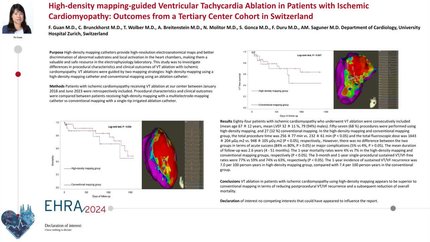
Substrate-based ablation has emerged as a successful technique for VT ablation, especially in patients with ischemic cardiomyopathy with markedly reduced left ventricular function. High-density mapping catheters provide high-resolution electroanatomical maps and better discrimination of abnormal substrates and local activation in the heart chambers, making them a valuable and safe resource in the electrophysiology laboratory.
The purpose of this study was to investigate differences in procedural characteristics and clinical outcomes of VT ablation with ischemic cardiomyopathy. VT ablations were guided by two mapping strategies: high-density mapping using a high-density mapping catheter and conventional mapping using an ablation catheter.
Patients with ischemic cardiomyopathy receiving VT ablation at our center between January 2018 and June 2023 were retrospectively included. Procedural characteristics and clinical outcomes were compared between patients receiving high-density mapping with a multielectrode-mapping catheter vs conventional mapping with a single-tip irrigated ablation catheter.
Eighty-four patients with ischemic cardiomyopathy who underwent VT ablation were consecutively included (mean age 67 ± 12 years, mean LVEF 32 ± 11 %, 79 (94%) males). Fifty-seven (68 %) procedures were performed using high-density mapping, and 27 (32 %) conventional mapping. In the high-density mapping and conventional mapping group, the total procedure time was 256 ± 77 min vs. 232 ± 61 min (P < 0.05) and the total fluoroscopic dose was 1643 ± 204 μGy.m2 vs. 948 ± 105 μGy.m2 (P < 0.05), respectively,. However, there was no difference between the two groups in terms of acute success (84% vs 80%, P > 0.05) or major complications (5% vs 4%, P > 0.05). The mean duration of follow-up was 2.6 years (4 - 51 months). The 1-year mortality rates were 4% vs 7% in the high-density mapping and conventional mapping groups, respectively (P < 0.05). The 3-month and 1-year single-procedural sustained VT/VF-free rates were 77% vs 59% and 74% vs 63%, respectively (P < 0.05). The 1-year incidence of sustained VT/VF recurrence was 7.0 per 100 person-years in high-density mapping group, compared with 7.4 per 100 person-years in the conventional group.
VT ablation in patients with ischemic cardiomyopathy using high-density mapping appears to be superior to conventional mapping in terms of reducing postprocedural VT/VF recurrence and a subsequent reduction of overall mortality.
Contributors

T Wolber
Author
A Breitenstein
Author
N Molotor
Author
S Gonca
Author
F Duru
Author
A M Saguner
Author
You may be interested in