Biochemical markers of neuro-myocardial damage after pulmonary vein isolation: the effect of different energy sources
EP Europace Journal


Abstract
Pulmonary vein isolation (PVI) by thermal energy, both radiofrequency (RF) and cryoenergy(Cryo), is associated with a significant release of myocardial and collateral neural injury markers. Damage to periatrial ganglionated plexi also results in a substantial change in cardiac autonomic regulations. On the contrary, pulsed electric field (PEF) energy tends to spare cardiac neural tissue.
To quantify the impact of different ablation energy sources that are used for PVI on neuro-myocardial damage by the assessment of specific biomarkers.
A study enrolled 85 patients with paroxysmal atrial fibrillation who underwent PVI (age: 61 ± 12 years, 74% males). In 23 patients, RF energy was delivered by the irrigated-tip catheter, while 30 patients were ablated using a second-generation cryoballoon catheter. In 32 patients, PVI was performed using a multipolar pentaspline catheter and PEF energy. Peripheral venous blood samples for assessing the plasmatic levels of S100 calcium-binding protein B (S100B), neuron-specific enolase (NSE), high-sensitivity troponin I and T (hsTnI and hsTnT) were obtained before, immediately after the PVI, and the next day (usually 18-24 hours after the procedure). Study groups were compared regarding absolute biomarker levels and hsTnT/S100B ratio (a surrogate of cardioselectivity).
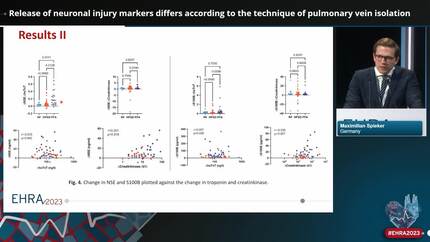
Following successful PVI, a significant increase in plasma levels of all biomarkers was observed: DhsTnT = 1040±434 ng/L, 1731±830 ng/L and 1010±397 ng/L; DhsTnI = 1504±918 ng/L, 16464±11911 ng/L and 10789±7589 ng/L; DS100B: 0.04±0.02 mg/L, 0.03±0.04 mg/L and 0.14±0.08 mg/L; DNSE: 34±72 ng/mL, 27±53 ng/mL and 45±52 ng/mL (all with P <0.001) for RF, PEF and Cryo groups, respectively. A direct comparison of maximal biomarker levels between study groups is depicted in the Figure. The hsTnT/S100B ratio was 23±14, 12±6, and 6±3 in PEF, RF, and Cryo groups, respectively (ANOVA P <0.01), indicating that PEF was 1.9-times and 3.8-times more cardioselective than RF and Cryo, respectively. Following the PVI, the heart rate accelerated by 2±8, 13±14, and 9±11 bpm in the PEF, RF, and Cryo groups, respectively. No correlation was observed between S100B release and HR acceleration (R = 0.07, P = 0.55).
Compared to thermal energy sources, PEF energy induces more specific damage to cardiomyocytes than cardiac nerves. There was no correlation between S100B release and HR acceleration.
Contributors


H Alfredova
Author
V Filova
Author
D Wichterle
Author

R Cihak
Author
E Borisincova
Author
P Stiavnicky
Author
J Haskova
Author
J Kautzner
Author
You may be interested in