Difference between cryoballoon and radiofrequency ablations for atrial fibrillation based on electroanatomical mechanisms
EP Europace Journal


Abstract
Cryoballoon pulmonary vein isolation (PVI; Cryo-PVI) has comparable results to conventional radiofrequency PVI (RF-PVI) in patients with atrial fibrillation (AF). However, Cryo-PVI using a 28-mm cryoballoon has limitations for wide circumferential PVI or extra-pulmonary vein (PV) trigger (ExPVT) ablations. We compared long-term outcomes of Cryo-PVI and RF-PVI in patients without ExPVT and explored the potential electroanatomical mechanisms.
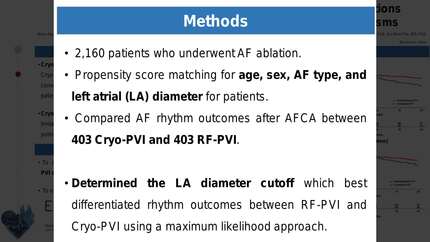
We identified 2,160 patients who underwent de novo AF ablation. After propensity score matching for age, sex, AF type, and left atrial (LA) diameter for patients without ExPVT (female 24.6%, mean 61.8years old, paroxysmal AF 53.2%), we compared rhythm outcomes between 403 Cryo-PVI and 403 RF-PVI procedures, considering AF type and LA size. We determined the LA diameter cutoff which best differentiated rhythm outcomes between RF-PVI and Cryo-PVI using a maximum likelihood approach based on the Cox proportional hazard model and investigated the relationship between PVI level and LA mass reduction through computational modeling.
During the 24 months of median follow-up, Cryo-PVI showed poorer rhythm outcomes to RF-PVI (Log-rank p=0.009) in overall patients. However, Cryo-PVI showed comparable overall rhythm outcomes to RF-PVI (Log-rank p=0.370) in patients with paroxysmal AF. Cryo-PVI showed higher AF recurrence in patients with larger LA size (LA diameter≥40mm; hazard ratio [HR] 1.55 [1.04-2.30]; log-rank p=0.030) or with persistent AF (log-rank p=0.001). In the computational modeling, PV antrum was likely to be covered by Cryo-PVI in patients with small LA, but not in those with large LA.
Cryo-PVI showed inferior rhythm outcomes than RF-PVI in patients with higher LA diameter or with persistent AF.
Contributors


D Kim
Author
Severance Cardiovascular Hospital, Yonsei University College of Medicine Seoul , Korea (Republic of)

K Kim
Author
H T Yu
Author
Severance Cardiovascular Hospital, Yonsei University College of Medicine Seoul , Korea (Republic of)
T H Kim
Author
Severance Hospital, Yonsei University College of Medicine Seoul , Korea (Republic of)


You may be interested in