Atrial high-rate episodes detected by cardiac implantable electronic devices: arrhythmic burden and progression towards de-novo clinical atrial fibrillation
EP Europace Journal


Abstract
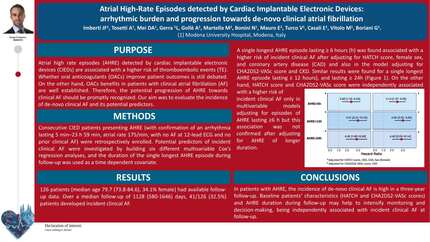
Atrial high rate episodes (AHRE) detected by cardiac implantable electronic devices (CIEDs) are associated with a higher risk of thromboembolic events, but whether oral anticoagulants (OACs) improve patient outcomes is still debated. On the other hand, OACs benefits in patients with clinical atrial fibrillation (AF) are well established. Therefore, the potential progression of AHRE towards clinical AF should be promptly recognized.
To evaluate the incidence of de-novo clinical AF and its potential predictors.
Consecutive CIED patients presenting AHRE (with confirmation of an arrhythmia lasting 5 min–23 h 59 min, atrial rate 175/min, with no AF at 12-lead ECG and no prior clinical AF) were retrospectively enrolled. Potential predictors of incident clinical AF were investigated by building six different multivariable Cox’s regression analyses, and the duration of the single longest AHRE episode during follow-up was used as a time-dependent covariate.
126 patients (median age 79.7 (73.8-84.6), 34.1% female) had available follow-up data. Detailed patients' characteristics are provided in Figure 1. Over a median follow-up of 1128 (580-1646) days, 41/126 (32.5%) patients developed incident clinical AF. A single longest AHRE episode lasting ≥ 6 hours (h) was found associated with a higher risk of incident clinical AF after adjusting for HATCH score, female sex, and coronary artery disease (CAD) (Hazard ratio (HR) 2.82; 95%CI 1.32-6.04) and also in the model adjusting for CHA2DS2-VASc score and CKD (HR 3.13; 95%CI 11.57-6.25). Similar results were found for a single longest AHRE episode lasting ≥ 12 hours (HR 4.91; 95%CI 2.31-10.42 and HR 4.90; 95%CI 2.50-9.60, respectively), and lasting ≥ 24h (HR 4.40; 95%CI 1.82-10.60 and HR 4.56; 95%CI 2.05-10.14, respectively) (Figure 2). On the other hand, HATCH score and CHA2DS2-VASc score were independently associated with a higher risk of incident clinical AF only in multivariable models adjusting for episodes of AHRE lasting ≥6 h (HR 1.42; 95%CI 1.02-1.97 and HR 1.37; 95%CI 1.03-1.83, respectively) but this association was not confirmed after adjusting for AHRE of longer duration.
In patients with AHRE, the incidence of de-novo clinical AF is high in a three-year follow-up. Baseline patients’ characteristics (HATCH and CHA2DS2-VASc scores) and AHRE duration during follow-up may help to intensify monitoring and decision-making, being independently associated with incident clinical AF at follow-up. Baseline characteristics Multivariate Cox's regression analysis




You may be interested in