Clinical determinants of blood biomarkers of atrial cardiomyopathy: results from the ISOLATION AF ablation cohort study
EP Europace Journal


Abstract
In patients with atrial fibrillation (AF), significant advances have been made in identifying biomarkers representing diverse pathophysiological pathways, such as inflammation, myocyte injury, collagen deposition, and fatty-fibrotic infiltration. Data on clinical determinants of biomarkers in patients with AF, however, are lacking.
Our primary aim was to explore the relationships between clinical determinants and biomarker levels in AF patients scheduled for catheter ablation.
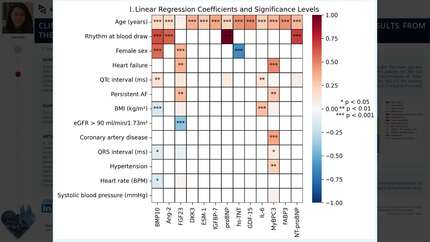
A cross-sectional analysis was conducted in AF patients undergoing catheter ablation included in the prospective multicenter ISOLATION study between July 2020 and May 2022. Clinical characteristics, routine tests and blood samples were collected before ablation. Blood samples were analyzed for known and novel cardiovascular biomarkers, including Bone morphogenetic protein 10 (BMP10), Angiopoietin-2 (Ang-2), Fibroblast growth factor 23 (FGF-23), Dickkopf-related protein 3 (DKK-3), Endocan (ESM-1), Insulin-like growth factor-binding protein 7 (IGFBP-7), B-type natriuretic peptides (proBNP, NTproBNP), High sensitive Troponin-T (hsTnT)< Growth differentiation factor 15 (GDF-15), interleukin 6 (IL-6), Fatty acid binding protein 3 (FABP3), Cancer antigen-125 (Ca-125) (Table 1). For each biomarker we trained a lasso regression model to identify the most important clinical determinants out of all the 60 available determinants (including anthropometry, ECG, comorbidities). The strongest associations are summarized in figure 1.
Blood samples of 508 patients were analyzed. The mean age was 63 ±9 years, and 31.1% were female. 354 patients (69.7%) had paroxysmal AF and 154 patients (30.3%) had persistent AF. Heart failure was reported in 77 patients (15.2%). 355 (72.3%) patients were in sinus rhythm during sample collection. The following clinical determinants of biomarker levels were frequently identified as important: rhythm during blood phlebotomy, age, heart failure, decreased kidney function and female sex (Figure 1). Most notably, rhythm at the time of sampling was strongly associated with various biomarker levels. Female sex was positively associated with BMP10 and FGF23 (atrial fibrosis), but negatively associated with hsTNT (cardiac injury).
In patients with AF scheduled for catheter ablation, we identified several clinical determinants of biomarker levels with potential implications for disease mechanisms. In women, pro-fibrotic biomarkers were frequently higher, while male patients more often showed signs of myocardial injury. Importantly, rhythm during blood draw is a very strong determinant of many biomarkers and should be taken into account in future biomarker studies.
Contributors



S A M Philippens
Author
S M Chaldoupi
Author
B A E Maesen
Author
S Zeemering
Author
Cardiovascular Research Institute Maastricht (CARIM) Maastricht , Netherlands (The)
D Linz
Author


U Schotten
Author
Cardiovascular Research Institute Maastricht (CARIM) Maastricht , Netherlands (The)
You may be interested in