Machine learning–based analysis of non-invasive measurements for predicting intracardiac pressures
European Heart Journal - Digital Health


Abstract
Early detection of congestion has demonstrated to improve outcomes in heart failure (HF) patients. However, there is limited access to invasively haemodynamic parameters to guide treatment. This study aims to develop a model to estimate the invasively measured pulmonary capillary wedge pressure (PCWP) using non-invasive measurements with both traditional statistics and machine learning (ML) techniques.
The study involved patients undergoing right-sided heart catheterization at Erasmus MC, Rotterdam, from 2017 to 2022. Invasively measured PCWP served as outcomes. Model features included non-invasive measurements of arterial blood pressure, saturation, heart rate (variability), weight, and temperature. Various traditional and ML techniques were used, and performance was assessed using
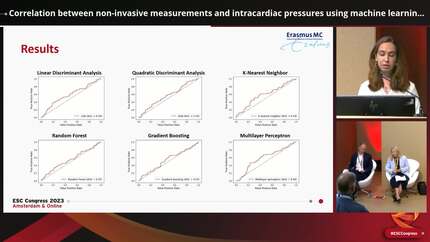
In this study, non-invasive methods, both traditional and ML-based, showed limited correlation to PCWP. This highlights the weak correlation between traditional HF monitoring and haemodynamic parameters, also emphasizing the limitations of single non-invasive measurements. Future research should explore trend analysis and additional features to improve non-invasive haemodynamic monitoring, as there is a clear demand for further advancements in this field.
Contributors

Annemiek E van Ravensberg
Author
Niels T B Scholte
Author
Aaram Omar Khader
Author
Jasper J Brugts
Author


You may be interested in