RIGHT VENTRICULAR TO PULMONARY ARTERY COUPLING AND IN–HOSPITAL OUTCOMES IN PATIENTS WITH SEVERE PRIMARY MITRAL REGURGITATION UNDERGOING CARDIAC SURGERY
European Heart Journal Supplements


Abstract
Recent data suggests that right ventricular to pulmonary artery (RV–PA) uncoupling negatively influences prognosis in several clinical conditions. Little is known about the role of RV–PA coupling in patients with mitral regurgitation (MR).
Our study aimed to investigate the role of RV–PA coupling in a cohort of patients with chronic severe primary MR (PMR) undergoing cardiac surgery.
We retrospectively assessed patients with severe PMR undergoing surgical repair or replacement from January 2018 to December 2021. Patients underwent preoperative transthoracic echocardiography and speckle tracking analysis. RV–PA coupling was assessed by the ratio of RV global longitudinal strain (RVGLS) and pulmonary artery systolic pressure (PASP). Patients were divided into tertiles according to RVGLS/PASP values. We studied the association between RV–PA coupling and the length of stay in the intensive care unit (ICU), the length of hospitalization and NYHA class at discharge.
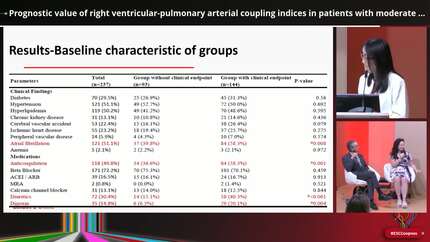
A total of 120 patients (mean age 65.2 ± 11.9 y) were included in the study. 84 (70%) patients underwent surgical valve repair while 36 (30%) underwent surgical valve replacement. Patients with lower RVGLS/PASP values had lower left ventricular ejection fraction (LVEF: 58.1±10.5% vs 62.0±7.4% vs 62.9±5.3%, p=0.018), more dilated left atrial volume (LAV: 71.0±21.9ml/m2 vs 62.3±21.2ml/m2 vs 55.9±23.9ml/m2, p=0.012) and lower peak atrial longitudinal strain values (PALS: 21.1 ± 10.1% vs 29.7 ± 11.0% vs 34.1 ± 9.4%, p<0.001). Patients with lower RVGLS/PASP ratio had longer hospital stay (11.5 ± 3.9 vs 10.4 ± 3.4 vs 8.5 ± 2.2 days, p<0.001) and stay in ICU (3.7 ± 2.0 vs 2.8 ± 2.4 vs 1.9 ± 1.3 days, p< 0.001). There was a significant inverse association between RVGLS/PASP and hospital stay and length of stay in ICU [for each 0.1%/mmHg increase: respectively β=–0.59 (–0.89; –0.29), p< 0.001 (Figure 1) and β=–0.35 (–0.53;–0.17), p<0.001 (Figure 2)]. Moreover, RVGLS/PASP was also associated with the probability of having a NYHA class ≥ 2 at discharge [OR 0.69(0.54; 0.89), p= 0.004 (Figure 3)]. These relationships were confirmed after adjustment for other variables.
Our study suggests that in patients with PMR undergoing cardiac surgery RV–PA coupling may identify a more compromised group of patients and that it is related to clinical outcomes in the very short–term after surgery.
Contributors

M Grieco
Author
A Bonelli
Author
S Guasti
Author
V Di Simone
Author
G De Sanctis
Author
B De Chiara
Author
L Cerrito
Author
C Russo
Author
C Giannattasio
Author
A Moreo
Author
You may be interested in