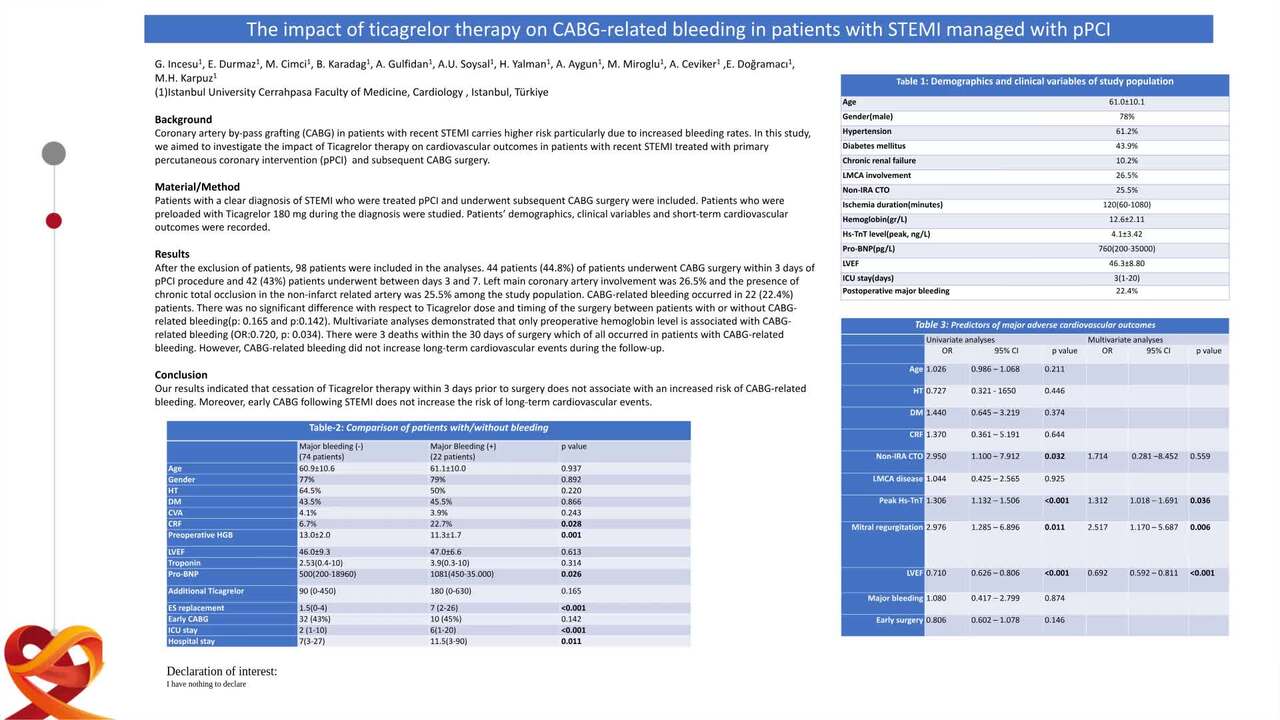
SAFETY AND EFFICACY OF EVOLOCUMAB IN PATIENTS WITH ACUTE CORONARY SYNDROME UNDERWENT TO CORONARY ARTERY BYPASS GRAFT: A COMPARATIVE RETROSPECTIVE ANALYSIS
European Heart Journal Supplements


Abstract
In–hospital reduction of low–density lipoprotein cholesterol (LDL–C) levels following the acute coronary syndrome (ACS) is recommended in the current clinical guidelines. However, the efficacy of proprotein convertase subtilisin–kexin type 9 (PCSK9) inhibitors (Evolocumab) in these patients undergoing surgical coronary revascularization has not been demonstrated.
From January 2022 to June 2023, we analyzed 74 patients presenting with ACS whose LDL–C levels were higher than guideline–recommended targets and underwent coronary bypass surgery. In the first period (January 2022– January 2023), the patients increased the Statin dosage and/or added Ezetimibe (Group STEZE 43 patients). At a later time (February 2023 – July 2023), the patients received not only Statin and ezetimibe but also evolocumab 140 mg every 2 weeks started as early as possible (Group STEVO 31 patients). One and three months after discharge the patients underwent a clinical and laboratory control with evaluation of the efficacy lipid measurements and every adverse event.
The two groups not differ in terms of risk factors as mean age (STEVO: 68.5±6.8 y.o. vs. STEZE 70±7.4 y.o. p=0.38), Diabetes (STEVO: 12–38.7% vs. STEZE 18–41.8%, p=0.79), previous myocardial infarction (STEVO: 7–22.6% vs. STEZE 10–23.2%, p=0.91) and Euroscore II (STEVO: 2.14±0.75 vs. STEZE 2.05±0.6, p=0.29). Also in terms of ACS (ST–, Instable angina or NSTE) and time of symptom onset, there is no difference between groups. Most patients (74.4% in STEZE and 71% in STEVO, p=0.88) were on no statin at baseline. Cholesterol, LDL–C and HDL trends from preprocedural to 3 months follow up in both groups demonstrating a more significative reduction in LDL–C and Cholesterol in STEVO group and no difference in HDL–C raising. No deaths were reported. In 3 STEZE group a recurrence of angina poses the need of re–revascularization. No of STEVO patients occur one major adverse event. The statistic difference in terms of these serious events 7% in STEZE vs. 0% in STEVO was not significant (p=0.26).
Evolocumab initiated “as soon as possible” in ACS submitted to CABG with high–intensity statin therapy and ezetimibe was well tolerated and resulted in a substantial reduction in LDL–C levels at dismission, 1 and 3 months. This laboratory result is associated with a reduction in repeated–revascularization.
Contributors

G Nasso
Author
C La Rosa
Author
F Bartolomucci
Author
M Brigiani
Author
M De Mola
Author
G Valenti
Author
V Amodeo
Author
G Contegiacomo
Author
D Hila
Author
I Condello
Author
G Speziale
Author
G Santarpino
Author
You may be interested in