WEARABLE CARDIOVERTER DEFIBRILLATOR IN PATIENT WITH TRANSIENT RISK OF SUDDEN CARDIAC DEATH : SINGLE CENTRE EXPERIENCE
European Heart Journal Supplements


Abstract
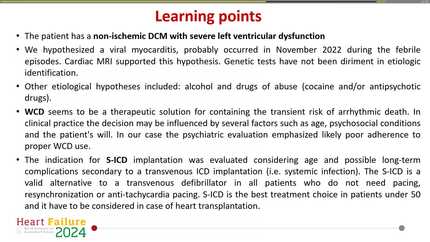
Cardiovascular disease is still the first cause of death, with sudden cardiac death ( SCD) as a first presentation in 25% of cases, related to coronary artery disease. Implantable cardioverter defibrillator (ICD) demontrated a reduction of SCD in high risk patients with good functional status. However the risk of SCD should be transient, so the use of a wearable cardioverter defibrillator (WCD) is considered in current guidelines and in clinical practice. The purpose of this study was to investigate the safety and the adherence to WCD in a real world population; moreover we reviewed the rate of ICD implantation after WCD use.
We considered consecutively 96 patients discharged from Piacenza cardiology department for potentially transient high risk of SCD, weared a WCD from August 2017 to June 2023. The patients were discharged in high risk mode of SCD with WCD protection and followed through remote monitoring or outpatient.A clinical and echocardiographic evalutation was performed at baseline and repeated at the end of the WCD use period.
Out of 95 patients , with average age 66,0 ±11,1 years old and baseline average left ventricular ejection fraction (LVEF) 28,6±7,5, 81,2% were males, 72,9% suffered from arterial hypertension, 26% diabetes mellitus, 13,5% peripheral vascular disease, 14,6% chronic renal failure, 4,1% previous stroke.66% of these patients weared WCD for severe systolic disfunction in ischemic cardiac disease after recent myocardial infarction, after percutaneous coronary intervention or coronary artery bypass graft, 4% after removal of an infected ICD, 6% whilst awaiting completion of diagnostic tests (chanalopathies/right arrhythmogenic ventricular cardiomyopathy), 24% newly diagnosed cardiomyopathy. The average wearing time of WCD was 22,7±3,1 hours daily. We received these events: 1 sustained ventricular tachicardia, 2 non sustained ventricular tachicardia, 5 atrial fibrillation with 3 T wave oversensing. One patient recedived inappropriate shock. One death was detected due to severe heart failure. After 56,0±37,8 days of average wearing time 52% of patients were scheduled for ICD implantation.
In our experience we may consider that WCD use is effective, safe and with a good adherence in all patients. The WCD allows saving resources preventing inapprpriate ICD implantation in patient with transient SCD risk.
Contributors

M Bolognesi
Author
L Rossi
Author
A Biagi
Author
C Sticozzi
Author
G Comastri
Author
F Puccio
Author
M Pisati
Author
D Aschieri
Author
You may be interested in