LONG–TERM OUTCOMES FOLLOWING TRANSVENOUS LEAD EXTRACTION: DATA FROM A TERTIARY REFERRAL CENTER
European Heart Journal Supplements


Abstract
Transvenous lead extraction (TLE) has been established as a procedure with a satisfactory safety and efficacy profile in both intraoperative and short–term postoperative setting. However, data on long–term outcomes are limited.
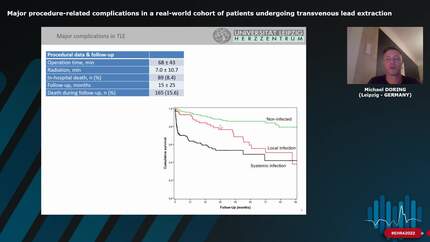
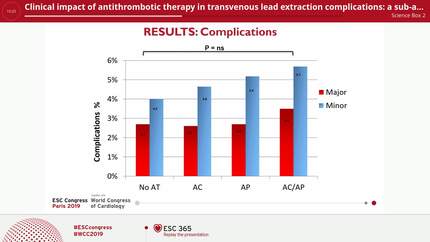
After a median follow–up of 6.5 years, the presence of infection at the time of TLE was associated with significantly lower event–free survival (67% vs. 83% in the non–infection group, adjusted hazard ratio [aHR] 1.97, 95% confidence interval [CI] 1.02–3.81, p = 0.04). The all–cause mortality rate was higher in the infected group (30% vs. 10%, p < 0.01). Conversely, the rate of repeated TLE did not differ significantly between the two groups (4% vs. 7%, p = 0.62). Among patients undergoing TLE due to infection, the presence of vegetations on leads or valvular apparatus (aHR 2.56; 95%CI 1.17–5.63, p = 0.02) and positive blood cultures (aHR 2.64; 95%CI 1.04–6.70, p = 0.04) were independently correlated with the primary outcome. Subgroup analysis based on gender revealed that female patients had a higher risk of minor intraprocedural and periprocedural complications (17.2% vs. 2.5%, p < 0.01), but no differences in long–term outcomes. Patients undergoing TLE for CIED–related infection demonstrate a high risk of long–term mortality. Systemic infection, indicated by vegetations and positive blood cultures, is associated with a worse prognosis, independent of the procedural complexity and success. Female patients exhibit an increased risk of minor intraprocedural and periprocedural complications.

You may be interested in