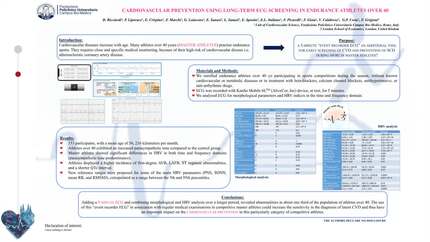
ECG SCREENING FOR CARDIOVASCULAR DISEASE IN ENDURANCE ATHLETES OVER 40
European Heart Journal Supplements


Abstract
Cardiovascular diseases (CVD) increase with age. There are many athletes aged >40 years who practise endurance sports, that involve very high intensity physical exertion and prolonged efforts. This population undergo to annual examination with a medical history, spirometry, urine test and exercise test. CV and sudden cardiac death are the main cause of mortality in athletes during sport, so this kind of screening remains controversial.
The population were selected as part of the larger ‘Heart And Run‘ project, an ECG collection of endurance athletes in Rome–Italy. A control group of healty individiuals was collected for comparison. The ECG traces were recorded at rest for 5 minutes with the Kardia Mobile 6L device. The study group were compared for an ECG morphological analysis and for HRV parameters in the time and frequency domain.
A total of 353 subjects (182 athletes and 171 controls) were analysed. The athlets show a significantly higher incidence of sinus arrhythmias, LAFB, 1° degree AV Block, J–point elevation and ST–segment abnormalities. We found also a significantly shorter QTc in athlets compared to controls. In line with the ECG findings, the HRV PNS and SNS indices were respectively higher and lower in the athlete group than in the controls, confirming a higher vagal tone. Due to the absence of normality range, we considered values lower of the 5th or higher of the 95th percentile range, for the main HRV parameters, as abnormals. We identified 29/182 virtually abnormal HRV individuals. Those patients could be at increased CV risk, worthy of further investigation. In total, out–of–range HRV values or morphological abnormalities were detected in 54 athletes (29% of the total), a population that will need further attention through follow–up and additional examinations.
Despite competitive endurance sports are associated with increased vagal tone, which is virtually protective against CV diseases, even in athletes over 40, the addition of the 5–minute ‘Event Recorder ECG‘ could increase the sensitivity in detection of CVD suggesting additional clinical and instrumental investigations in such patients.
Contributors

P Liporace
Author
D Ricciardi
Author
E Crispino
Author
F Marchi
Author
M D‘Amore
Author
G Loiacono
Author
L Sanasi
Author
E Sposito
Author
E Italiano
Author
F Picarelli
Author
V Calabrese
Author
F Gioia
Author
F Grigioni
Author
G Ussia
Author
You may be interested in