Heart failure-induced microbial dysbiosis contributes to colonic tumour formation in mice
Cardiovascular Research


Abstract
Heart failure (HF) and cancer are the leading causes of death worldwide. Epidemiological studies revealed that HF patients are prone to develop cancer. Preclinical studies provided some insights into this connection, but the exact mechanisms remain elusive. In colorectal cancer (CRC), gut microbial dysbiosis is linked to cancer progression and recent studies have shown that HF patients display microbial dysbiosis. This current study focussed on the effects of HF-induced microbial dysbiosis on colonic tumour formation.
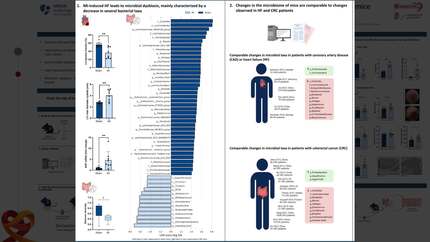
C57BL/6J mice were subjected to myocardial infarction (MI), with sham surgery as control. After six weeks faeces were collected, processed for 16 s rRNA sequencing, and pooled for faecal microbiota transplantation. CRC tumour growth was provoked in germ-free mice by treating them with Azoxymethane/Dextran sodium sulphate. The CRC mice were transplanted with faeces from MI or sham mice. MI-induced HF resulted in microbial dysbiosis, characterized by a decreased α-diversity and microbial alterations on the genus level, several of which have been associated with CRC. We then performed faecal microbiota transplantation with faeces from HF mice in CRC mice, which resulted in a higher endoscopic disease score and an increase in the number of tumours in CRC mice.
We demonstrated that MI-induced HF contributes to colonic tumour formation by altering the gut microbiota composition, providing a mechanistic explanation for the observed association between HF and increased risk for cancer. Targeting the microbiome may present as a tool to mitigate HF-associated co-morbidities, especially cancer.
Contributors

Sanne de Wit
Author
Lotte Geerlings
Author
Canxia Shi
Author
Just Dronkers
Author
Elisabeth M Schouten
Author
Gillian Blancke
Author
Vanessa Andries
Author
Tess Yntema
Author
Wouter C Meijers
Author
Debby P Y Koonen
Author
Lars Vereecke
Author
Herman H W Silljé
Author
Joseph-Pierre Aboumsallem
Author

You may be interested in