Incidence and predictors of thermal oesophageal and vagus nerve injuries in Ablation Index-guided high-power-short-duration ablation of atrial fibrillation: a prospective study
EP Europace Journal


Abstract
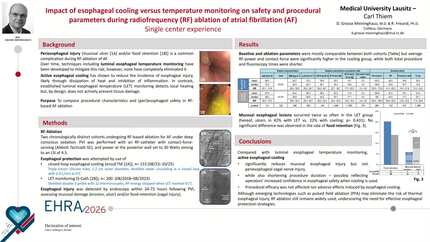
High-power-short-duration (HPSD) ablation is an effective treatment for atrial fibrillation but poses risks of thermal injuries to the oesophagus and vagus nerve. This study aims to investigate incidence and predictors of thermal injuries, employing machine learning.
A prospective observational study was conducted at Leipzig Heart Centre, Germany, excluding patients with multiple prior ablations. All patients received Ablation Index-guided HPSD ablation and subsequent oesophagogastroduodenoscopy. A machine learning algorithm categorized ablation points by atrial location and analysed ablation data, including Ablation Index, focusing on the posterior wall. The study is registered in
The low thermal lesion’s rate (7.6%) during Ablation Index-guided HPSD ablation for atrial fibrillation is noteworthy. Machine learning based ablation data analysis identified several potential predictors of thermal injuries. The correlation between machine learning output and injury development suggests the potential for a clinical tool to enhance procedural safety.
Contributors

Katharina Langenhan
Author
Marc Wolff
Author
Elena Efimova
Author
Markus Zachäus
Author
Angeliki Darma
Author
Borislav Dinov
Author
Timm Seewöster
Author
Sotirios Nedios
Author

Jan Wolff
Author
Ingo Paetsch
Author
Cosima Jahnke
Author
Andreas Bollmann
Author
Gerhard Hindricks
Author
Kerstin Bode
Author
Ulrich Halm
Author

You may be interested in