The role of cellular senescence in profibrillatory atrial remodelling associated with cardiac pathology
Cardiovascular Research


Abstract
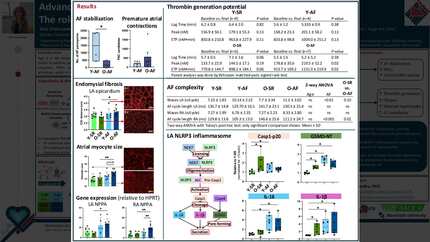
Cellular senescence is a stress-related or aging response believed to contribute to many cardiac conditions; however, its role in atrial fibrillation (AF) is unknown. Age is the single most important determinant of the risk of AF. The present study was designed to (i) evaluate AF susceptibility and senescence marker expression in rat models of aging and myocardial infarction (MI), (ii) study the effect of reducing senescent-cell burden with senolytic therapy on the atrial substrate in MI rats, and (iii) assess senescence markers in human atrial tissue as a function of age and the presence of AF.
AF susceptibility was studied with programmed electrical stimulation. Gene and protein expression was evaluated by immunoblot or immunofluorescence (protein) and digital polymerase chain reaction (PCR) or reverse transcriptase quantitative PCR (messenger RNA). A previously validated senolytic combination, dasatinib and quercetin, (D+Q; or corresponding vehicle) was administered from the time of sham or MI surgery through 28 days later. Experiments were performed blinded to treatment assignment. Burst pacing-induced AF was seen in 100% of aged (18-month old) rats, 87.5% of young MI rats, and 10% of young control (3-month old) rats (
Our results point to a potentially significant role of cellular senescence in AF pathophysiology. Modulating cell senescence might provide a basis for novel therapeutic approaches to AF.
Contributors

Patrice Naud
Author
Issam H Abu-Taha
Author
Roddy Hiram
Author
Feng Xiong
Author
Jiening Xiao
Author
Mozhdeh Mehdizadeh
Author
Arnela Saljic
Author
Markus Kamler
Author
Nhung Vuong-Robillard
Author
Eric Thorin
Author
Gerardo Ferbeyre
Author
Jean-Claude Tardif
Author
Martin G Sirois
Author
Jean Francois Tanguay
Author
Dobromir Dobrev
Author

You may be interested in