Utilization of and perceived need for simulators in clinical electrophysiology: results from an EHRA physician survey
EP Europace Journal


Abstract
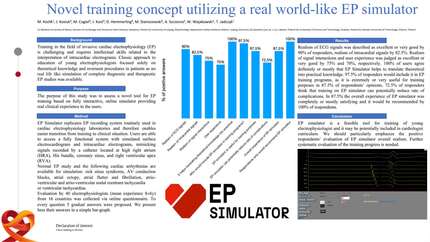
Simulator training has been recently introduced in electrophysiology (EP) programmes in order to improve catheter manipulation skills without complication risks. The aim of this study is to survey the current use of EP simulators and the perceived need for these tools in clinical training and practice.
A 20-item online questionnaire developed by the Scientific Initiatives Committee of the European Heart Rhythm Association (EHRA) in collaboration with EHRA Digital Committee was disseminated through the EHRA Scientific Research Network members, national EP groups, and social media platforms. Seventy-four respondents from 22 countries (73% males; 50% under 40 years old) completed the survey. Despite being perceived as useful among EP professionals (81%), EP simulators are rarely a part of the institutional cardiology training programme (20%) and only 18% of the respondents have an EP simulator at their institution. When available, simulators are mainly used in EP to train transseptal puncture, ablation, and mapping, followed by device implantation (cardiac resynchronization therapy [CRT], leadless, and conduction system pacing [CSP]). Almost all respondents (96%) believe that simulator programmes should be a part of the routine institutional EP training, hopefully developed by EHRA, in order to improve the efficacy and safety of EP procedures and in particular CSP 58%, CRT 42%, leadless pacing 38%, or complex arrhythmia ablations (VT 58%, PVI 45%, and PVC 42%).
This current EHRA survey identified a perceived need but a lack of institutional simulator programme access for electrophysiologists who could benefit from it in order to speed up the learning curve process and reduce complications of complex EP procedures.
Contributors

Fleur V Y Tjong
Author

Andreas Goette
Author

Kevin Vernooy
Author
Serge Boveda
Author

Emma Svennberg
Author
You may be interested in