Quality and transparency of evidence for implantable cardiovascular medical devices assessed by the CORE-MD consortium
European Heart Journal


Abstract
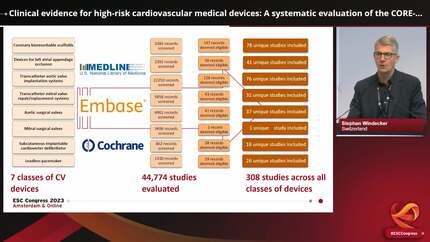
The European Union Medical Device Regulation 2017/745 challenges key stakeholders to follow transparent and rigorous approaches to the clinical evaluation of medical devices. The purpose of this study is a systematic evaluation of published clinical evidence underlying selected high-risk cardiovascular medical devices before and after market access in the European Union (CE-marking) between 2000 and 2021.
Pre-specified strategies were applied to identify published studies of prospective design evaluating 71 high-risk cardiovascular devices in seven different classes (bioresorbable coronary scaffolds, left atrial appendage occlusion devices, transcatheter aortic valve implantation systems, transcatheter mitral valve repair/replacement systems, surgical aortic and mitral heart valves, leadless pacemakers, subcutaneous implantable cardioverter-defibrillator). The search time span covered 20 years (2000–21). Details of study design, patient population, intervention(s), and primary outcome(s) were summarized and assessed with respect to timing of the corresponding CE-mark approval.
At least one prospective clinical trial was identified for 70% (50/71) of the pre-specified devices. Overall, 473 reports of 308 prospectively designed studies (enrolling 97 886 individuals) were deemed eligible, including 81% (251/308) prospective non-randomized clinical trials (66 186 individuals) and 19% (57/308) randomized clinical trials (31 700 individuals). Pre-registration of the study protocol was available in 49% (150/308) studies, and 16% (48/308) had a peer-reviewed publicly available protocol. Device-related adverse events were evaluated in 82% (253/308) of studies. An outcome adjudication process was reported in 39% (120/308) of the studies. Sample size was larger for randomized in comparison to non-randomized trials (median of 304 vs. 100 individuals,
The quantity and quality of publicly available data from prospective clinical investigations across selected categories of cardiovascular devices, before and after CE approval during the period 2000–21, were deemed insufficient. The majority of studies was non-randomized, with increased risk of bias, and performed in small populations without provision of power calculations, and none of the reviewed devices had randomized trial results published prior to CE-mark certification.
Contributors


Bernadette Coles
Author
Jonas D Häner
Author
Laurna McGovern
Author
Joanna Bartkowiak
Author
J J Coughlan
Author
Alessandro Spirito
Author
Roberto Galea
Author
Andreas Haeberlin
Author

Daijiro Tomii
Author
Tom Melvin
Author
André Frenk
Author
Robert A Byrne
Author
Alan G Fraser
Author

You may be interested in