Identification of Brugada syndrome based on P-wave features: an artificial intelligence-based approach
EP Europace Journal


Abstract
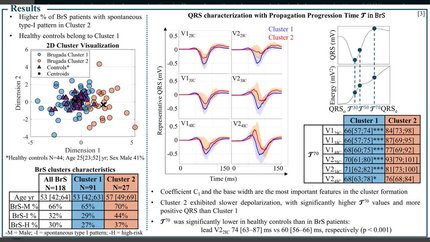
Brugada syndrome (BrS) is an inherited disease associated with an increased risk of ventricular arrhythmias. Recent studies have reported the presence of an altered atrial phenotype characterized by abnormal P-wave parameters. The aim of this study was to identify BrS based exclusively on P-wave features through an artificial intelligence (AI)-based model.
Continuous 5 min 12-lead ECG recordings were obtained in sinus rhythm from (i) patients with spontaneous or ajmaline-induced BrS and no history of AF and (ii) subjects with suspected BrS and negative ajmaline challenge. The recorded ECG signals were processed and divided into epochs of 15 s each. Within these epochs, P-waves were first identified and then averaged. From the averaged P-waves, a total of 67 different features considered relevant to the classification task were extracted. These features were then used to train nine different AI-based supervised classifiers. A total of 2228 averaged P-wave observations, resulting from the analysis of 33 420 P-waves, were obtained from 123 patients (79 BrS+ and 44 BrS−). Averaged P-waves were divided using a patient-wise split, allocating 80% for training and 20% for testing, ensuring data integrity and reducing biases in AI-based model training. The BrS+ patients presented with longer P-wave duration (136 ms vs. 124 ms,
An AI machine-learning model is able to identify patients with BrS based only on P-wave characteristics. These findings confirm the presence of an atrial hallmark and open new horizons for AI-guided BrS diagnosis.
Contributors

Beatrice Zanchi
Author
Francesca Dalia Faraci
Author
Ali Gharaviri
Author

Tomas Monga
Author
Angelo Auricchio
Author

You may be interested in