Cardiac magnetic resonance–derived myocardial scar is associated with echocardiographic response and clinical prognosis of left bundle branch area pacing for cardiac resynchronization therapy
EP Europace Journal


Abstract
Left bundle branch area pacing (LBBAP) is a novel approach for cardiac resynchronization therapy (CRT), but the impact of myocardial substrate on its effect is poorly understood. This study aims to assess the association of cardiac magnetic resonance (CMR)–derived scar burden and the response of CRT via LBBAP.
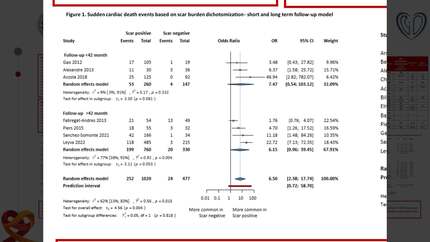
Consecutive patients with CRT indications who underwent CMR examination and successful LBBAP-CRT were retrospectively analysed. Cardiac magnetic resonance late gadolinium enhancement was used for scar assessment. Echocardiographic reverse remodelling and composite outcomes (defined as all-cause death or heart failure hospitalization) were evaluated. The echocardiographic response was defined as a ≥15% reduction of left ventricular end-systolic volume. Among the 54 patients included, LBBAP-CRT resulted in a 74.1% response rate. The non-responders had higher global, septal, and lateral scar burden (all
Lower scar burden was associated with higher response rate of LBBAP-CRT. The pre-procedure CMR scar evaluation provides further useful information to identify potential responders and clinical outcomes.
Contributors

Zhongli Chen
Author
Xuan Ma
Author
Yuan Gao
Author
Sijin Wu
Author
Nan Xu
Author
Feng Chen
Author
Yanyan Song
Author
Chongqiang Li
Author
Minjie Lu
Author
Yan Dai
Author
Shihua Zhao
Author
State Key Laboratory of Cardiovascular Disease, Fuwai Hospital, National Center for Cardiovascular D Beijing , China
Keping Chen
Author
You may be interested in