Electrocardiographic temporo-spatial assessment of depolarization and repolarization changes after epicardial arrhythmogenic substrate ablation in Brugada syndrome
European Heart Journal - Digital Health


Abstract
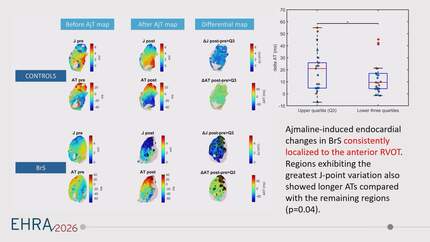
In Brugada syndrome (BrS), with spontaneous or ajmaline-induced coved ST elevation, epicardial electro-anatomic potential duration maps (epi-PDMs) were detected on a right ventricle (RV) outflow tract (RVOT), an arrhythmogenic substrate area (AS area), abolished by epicardial-radiofrequency ablation (EPI-AS-RFA). Novel CineECG, projecting 12-lead electrocardiogram (ECG) waveforms on a 3D heart model, previously localized depolarization forces in RV/RVOT in BrS patients. We evaluate 12-lead ECG and CineECG depolarization/repolarization changes in spontaneous type-1 BrS patients before/after EPI-AS-RFA, compared with normal controls.
In 30 high-risk BrS patients (93% males, age 37 + 9 years), 12-lead ECGs and epi-PDMs were obtained at baseline, early after EPI-AS-RFA, and late follow-up (FU) (2.7–16.1 months). CineECG estimates temporo-spatial localization during depolarization (Early-QRS and Terminal-QRS) and repolarization (ST-Tpeak, Tpeak-Tend). Differences within BrS patients (baseline vs. early after EPI-AS-RFA vs. late FU) were analysed by Wilcoxon signed-rank test, while differences between BrS patients and 60 age–sex-matched normal controls were analysed by the Mann–Whitney test. In BrS patients, baseline QRS and QTc durations were longer and normalized after EPI-AS-ATC (151 ± 15 vs. 102 ± 13 ms,
CineECG and 12-lead ECG showed a complex temporo-spatial perturbation of both depolarization and repolarization in BrS patients, prevalently localized in RV/RVOT, progressively normalizing after epicardial ablation.
Contributors



Giuseppe Ciconte
Author
Francesca Heilbron
Author

Gabriele Vicedomini
Author
Emanuele Micaglio
Author
Žarko Ćalović
Author
Luigi Anastasia
Author
Vincenzo Santinelli
Author
Carlo Pappone
Author
You may be interested in