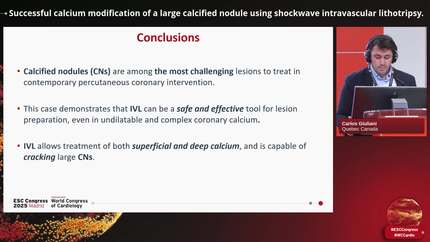
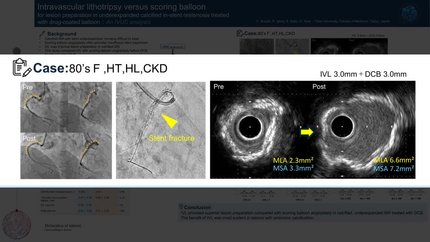
A case report on intravascular lithotripsy to facilitate retrograde wire passage from the subintimal to the luminal space in a calcified chronic total occlusion
European Heart Journal - Case Reports


Abstract
Severe calcifications are a major reason for failures in chronic total coronary occlusions, as they can obstruct the wire passage both in the antegrade and retrograde technique.
The proximal occlusion of the left anterior descending artery in a 75-year-old man presented with a completely concentric calcified ring all along the segment proximal to the occlusion. The antegrade wire could not pass the calcified occlusion, and in a retrograde approach
Intravascular lithoplasty is a new option to modify severely calcified vessel segments to facilitate the reverse controlled antegrade and retrograde tracking approach. In the present case, this helped to avoid a long subintimal pathway and preserved the vessel anatomy.
Contributors

Kenji Yaginuma
Author
Grigoris Karamasis
Author
Andreas Kalogeropoulos
Author
Ralph Mark Louis Neijenhuis
Author
You may be interested in