Spontaneous coronary artery dissection in women with acute myocardial infarction: is there a new role for autoimmunity?
European Heart Journal - Acute CardioVascular Care


Abstract
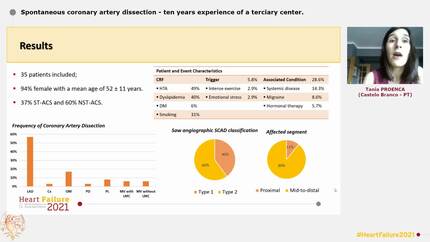
Spontaneous coronary artery dissection (SCAD) is an uncommon cause of acute myocardial infarction in women and has an unclear pathophysiology. Autoantibodies (AAs) targeting angiotensin-II receptor type 1 (AT1R) and endothelin-1 receptor type A (ETAR) have known detrimental effects on endothelial function. We investigated the prevalence of these AAs in SCAD-affected female patients.
Female patients diagnosed at coronary angiography with myocardial infarction and SCAD were consecutively enrolled. Autoantibodies targeting angiotensin-II receptor type 1 and ETAR-AA titres and seropositivity prevalence were compared between SCAD patients, ST-elevation myocardial infarction (STEMI) patients, and healthy women. Ten women with SCAD and 20 age-matched controls (10 women with STEMI and 10 healthy women) were included. Six out of 10 (60%) women with myocardial infarction and SCAD were seropositive for AT1R-AAs and ETAR-AAs. In contrast, only one (10%) healthy woman and one (10%) STEMI patient were seropositive for AT1R-AAs (
Autoantibodies targeting angiotensin-II receptor type 1 and ETAR-AA seropositivity is significantly higher in SCAD women with myocardial infarction than in healthy women or female patients with STEMI. Our findings, corroborated by previous data in the literature and biological plausibility, suggest a possible role for AT1R-AAs and ETAR-AAs in the pathophysiology of SCAD in women with acute myocardial infarction and should warrant further studies with larger sample sizes.
Contributors

Giovanni Civieri
Author
Marta Vadori
Author
Giulia Masiero
Author
Laura Iop
Author
Donatella Tansella
Author
Valeria Pergola
Author
Emanuele Cozzi
Author
Sabino Iliceto
Author
You may be interested in