Renal function and decongestion with acetazolamide in acute decompensated heart failure: the ADVOR trial
European Heart Journal


Abstract
In the ADVOR trial, acetazolamide improved decongestion in acute decompensated heart failure (ADHF). Whether the beneficial effects of acetazolamide are consistent across the entire range of renal function remains unclear.
This is a pre-specified analysis of the ADVOR trial that randomized 519 patients with ADHF to intravenous acetazolamide or matching placebo on top of intravenous loop diuretics. The main endpoints of decongestion, diuresis, natriuresis, and clinical outcomes are assessed according to baseline renal function. Changes in renal function are evaluated between treatment arms.
On admission, median estimated glomerular filtration rate (eGFR) was 40 (30–52) mL/min/1.73 m². Acetazolamide consistently increased the likelihood of decongestion across the entire spectrum of eGFR (
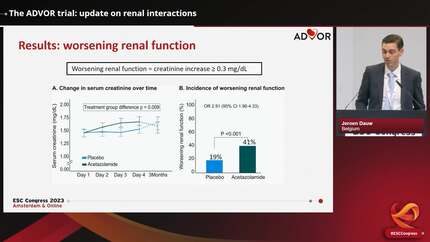
Acetazolamide is associated with a higher rate of successful decongestion across the entire range of renal function with more pronounced effects regarding natriuresis and diuresis in patients with a lower eGFR. While WRF occurred more frequently with acetazolamide, this was not associated with adverse clinical outcomes.
NCT03505788.
Contributors



Pieter Martens
Author

Frederik H Verbrugge
Author
Petra Nijst
Author
Jozine M ter Maaten
Author

Alexandre Mebazaa
Author
Gerasimos Filippatos
Author
Frank Ruschitzka
Author
Wai Hong Wilson Tang
Author
Matthias Dupont
Author

You may be interested in